

A set of playground seesaws. (Photo credit: Wikipedia)
“Happiness is not a matter of intensity but of balance, order, rhythm and harmony.” Thomas Merton
We are closing on the end of the year, which always makes me thoughtful. I tend to not only assess the last year for what I did and didn’t do, but to reassess my life as well.
Those who know me well, know I am an intense person, prone to throwing myself fully into whatever engages me. It is the routine I struggle with, pacing time and commitment, parsing it out little by little, doing step by step. Finding balance. Hard for an all-in kind of person. So, this time of year, I go back to the lessons I have learned the hard way in the skinned knees of my youth and the bruises to my ego of my adult mistakes.
Many say we learn a lot in kindergarden. I think many of those lessons were taught on the playground. I was one of the smallest and skinniest kids in my school. This was no impediment in class. I excelled. And in most sports I was fast and accurate, one of the first chosen. The only place I was at an extreme disadvantage was on the teeter-totter.
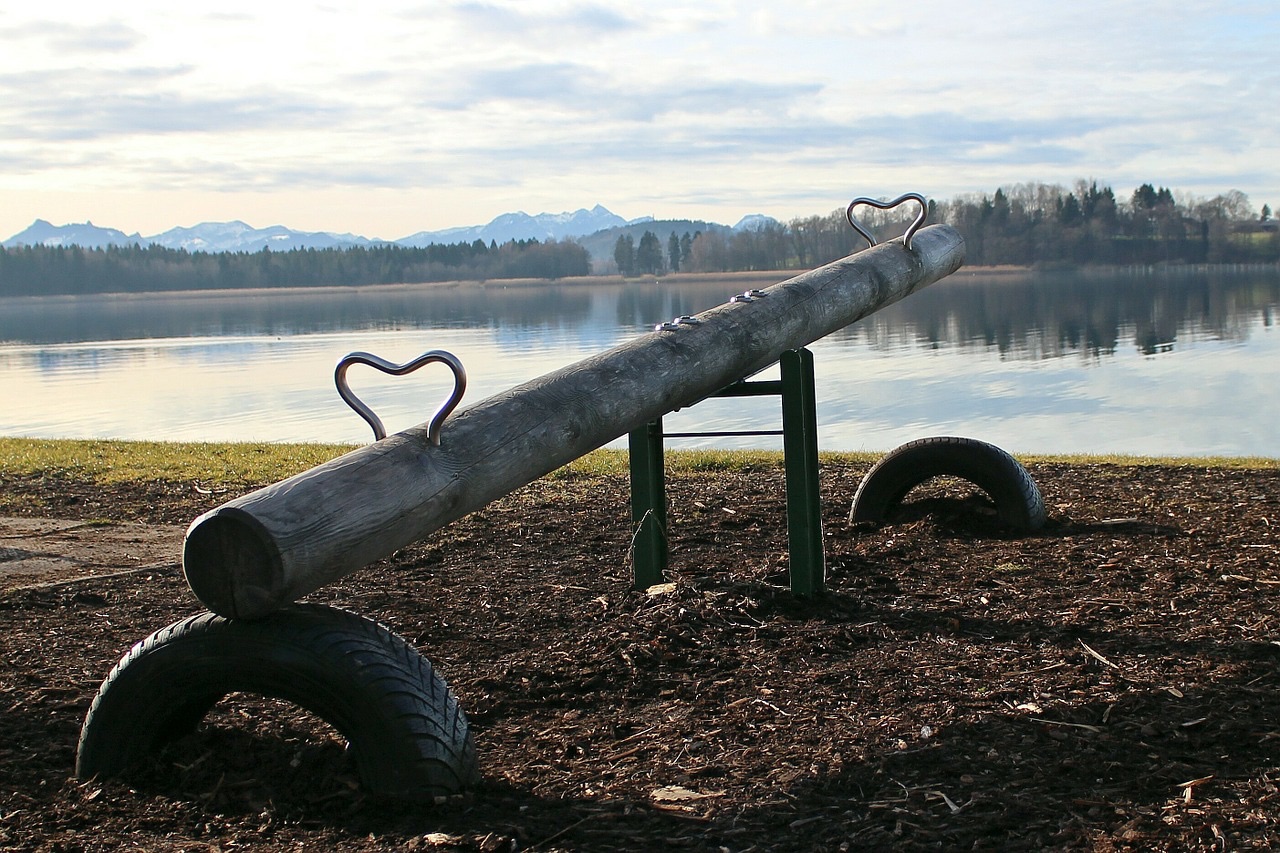 Our playground had several and they were highly sought after. Usually, the biggest kids dominated them, not good for a light-weight like me. As in most things, I wanted to master it, so I got on with any kid who offered me the chance. But even though our seesaws had adjustable settings to reposition the board lengths to account for different sizes, the results were always the same. My ‘partner’ would sink to the ground, and I would sit, up in the air, helpless.
“Ask me nicely and I might let you down, ” ‘Mary’ would taunt.
“No! Never,” I would refuse.
“Say pretty please,” she’d demand.
“No, I won’t.”
Her eyes would narrow, her voice grow nasty, “Say pretty please with a cherry on top.”
“I’ll never do anything you ask.” I would try to match her tone. (Did I tell you I could be stubborn as well as intense?)

Seesaw with a crowd of children playing (Photo credit: Wikipedia)
You can guess what happened next. Off she would climb. Down I would go, crashing to the ground.
Sometimes I tried just not responding. I steeled myself not to react, knowing it was my distress that fueled the enjoyment. But if I refused to “play,” again the result was pretty predictable. I did learn not to get hurt. I would be ready to land on my feet. That was followed by a refusal to let me on the seesaw at all. A standoff. Then, sooner or later, someone would convince me or I would convince myself, that the outcome would be different. Remember Charlie Brown and Lucy …….and the football?
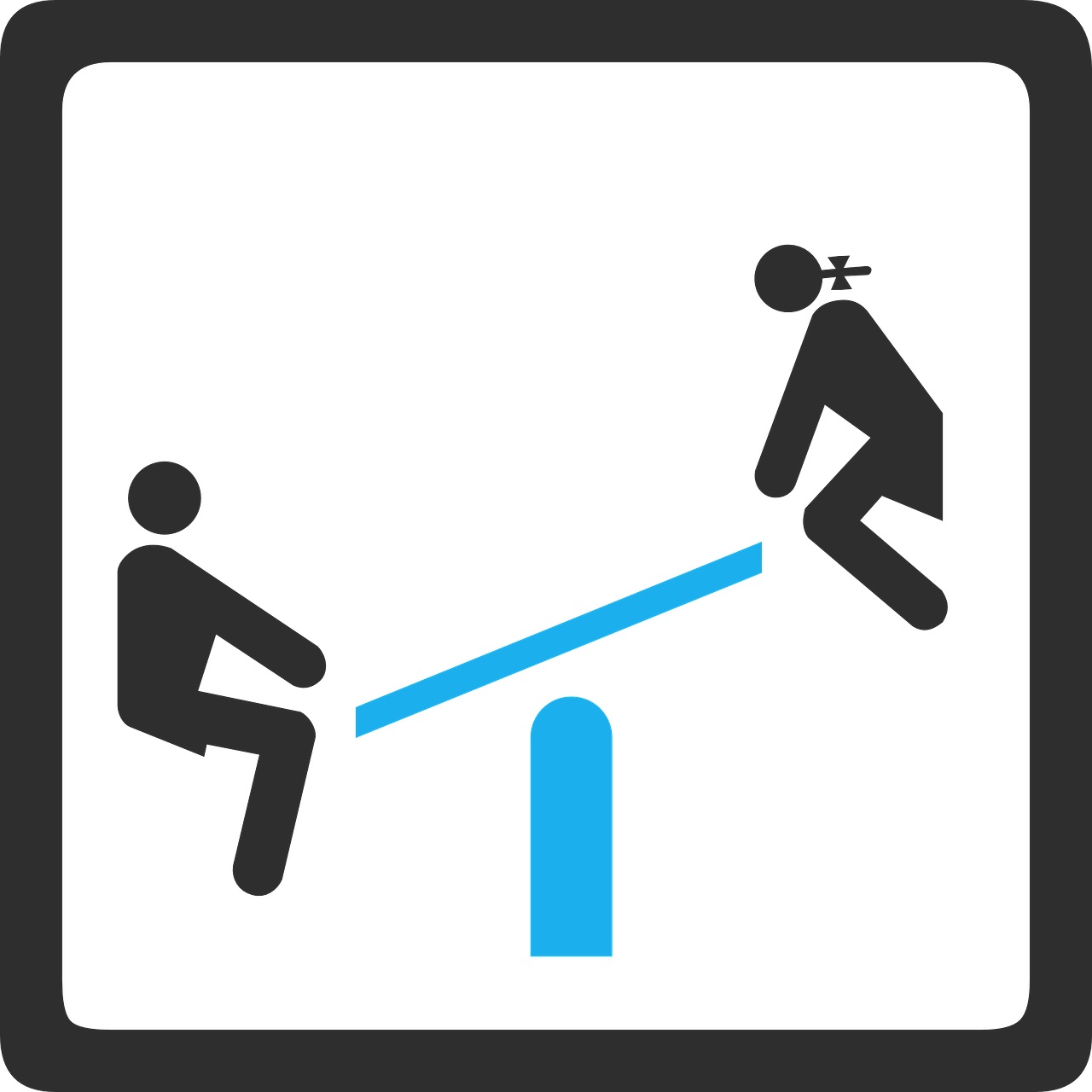 This went on and on until one day I was one of the big kids, still small and slight, but older and bigger. At first my revenge was to play nicely with some of the younger kids. I gave them the chance I never got and up and down we would ride, just the way you are supposed to.
But I found it strangely tame. Something inside felt unsatisfied, incomplete. You see, I was avoiding the big kids. So had I mastered the teeter totter or had it mastered me?
Then one day, after school, when everyone had left the playground, I found an answer.
There was the bank of seesaws, the boards sitting on the ground. They invited me, yet taunted me. For some reason, I went and stood on the seat of the first one. Then I started walking. Slowly up the board I went. As I moved, the board began to move. But because I was light-weight, I could manage to keep the balance. The end I started on rose as the high end lowered, until I got to the middle. Joy washed over me. The board was absolutely level and I had defeated it. Then I slowly walked my way to the ground on the other side, the hardest part. Perfect.
Now, I was still a kid. I’d like to say that my victory on the playground felt complete at that moment. It didn’t. I repeated my balancing act on all four boards. Success. The next day, I waited for playground time.
First, I confidently demonstrated my feat to everyone. Then, I challenged “Mary,” the one who had picked on me the worst, to repeat my action.
She was actually afraid. I saw it in her eyes, but she couldn’t dare to show it. She was a big kid. She hesitated while I waited.
She tried to blow it off. “That’s stupid.”
“So, if it’s so stupid, let’s see you do it.” I baited her.
Then, the other kids, even her friends, began to cheer her and taunt her and me. “Show her, show her, Mary. Sure Mary, you’re the seesaw queen. Do it. You can do it. Scaredy Cat, do it! You afraid to try?”
Of course she had to. And she couldn’t. Mary was too big. She climbed with just a few shaky steps but the minute she crossed the center the previously air-born end of the board crashed to the ground. She lost her balance and had to jump off. From that moment on, Mary never challenged me on anything. And the biggest game on the playground became seeing who could walk the seesaw.

Cover via Amazon
I thought I won. And though it took a while, eventually I realized that my challenge and my “victory” were just the same as hers over me. I set Mary up for defeat and gloated at her failure. I had my moment of intense and admittedly satisfying victory. But I did not have balance, though I thought I did. Ultimately on the playground, like in life, we often miss our real enemy. It certainly wasn’t Mary or any of the big kids. And really, it wasn’t the seesaw. As Pogo would say on the comic pages of my childhood, “We have met the enemy and he is US.” Or me.
I don’t know if Charlie Brown ever read Walt Kelly. I did. (Besides intense and stubborn I was a pretty precocious reader.) But I didn’t get Pogo till much later. Probably not until around the time I discovered Merton. Because intensity feels really great at the moment. It’s like tilting at windmills. Or spiking the football. It is over the top. But, it is erratic and unbalanced. It is the hare who lives in the world of tortoises.
Yet, as Merton noted, it does not create happiness. That is something that requires more than intensity, like letting others walk with us instead of running ahead and being impatient with their slowness. It takes living in rhythm with the world, in harmony with our fellow travelers within it. It comes in seeing the best in others, in finding strengths in the Marys.
It took me a while to see that everyone has a role in God’s universe. There is a place for the order of step by step people, as well as the creativity of innovators. That is the real balance to the teeter totter of life – up and down. Some of this and some of that. Not canceling each other out – not stillness – but movement that is rhythm and harmony.
A good lesson to remember in the new year ahead. One of the best, one I already know. Hey Charlie Brown, forget football! Common, let’s go ride the seesaw.


 I have heard discussions and read posts by folks who seem to feel that the loss of the election was a kind of beginning to the end. One posted comments about the
 And of course these events come on top of the last several years of economic struggles, during which along with 10% of North Carolina I was unemployed for more than a year. Again it seems like there are very distinct ways that people have reacted to these tough times. I think all of us have defaults set to cup half-full or cup half-empty positions.
 At that time I stumbled across a quote that has stuck with me through subsequent times of trial. It is by
  The remarkable thing is we have a choice everyday regarding the attitude we will embrace for that day. We cannot change our past. We cannot change that people will act in a certain way. We cannot change the inevitable. The only thing we can do is play on the one string we have, and that is our attitude. I am convinced that life is 10% what happens to me and 90% how I react to it.”
 How powerful that one string is! He’s right. The past is done and cannot be changed by regret or second guessing it. The future can be built by choices made in the present but still is unknowable. But today, today is where we live. And we can actually decide how we experience it, even if we are natural half-cup people. We can look at the vagaries of life, the losses, the problems, and choose to be happy anyway. We can live and love and laugh in the now, despite everything.
 And even if we only have one string, we can play it for all we’re worth, adding our note to the plinks of others, creating a symphony.


 joanneeddy's blog