Mother of Exiles – An Old Immigrant Tale


Looking north at JC and Statue of liberty

Looking north at JC and Statue of liberty (Photo credit: Wikipedia)

On October 27, 1886, the Statue of Liberty was dedicated. On it’s base is a bronze plaque with this poem, of which only a few lines are now remembered…except in the hearts of all the immigrants who came through Ellis Island…or their children and grandchildren.

Plaque of The New Colossus poem by Emma Lazaru...

Plaque of The New Colossus poem by Emma Lazarus (“Mother of Exiles”) in the museum inside the pedestal of the Statue of Liberty. Plaque was erected in 1903, see here (Photo credit: Wikipedia)

 The New Colossus                                                                                             

Not like the brazen giant of Greek fame, With conquering limbs                                                        astride from land to land; Here at our sea-washed, sunset gates shall stand  A mighty woman with a torch, whose flame Is the imprisoned lightning, and her name,   Mother of Exiles.  

From her beacon-hand Glows world-wide welcome; her mild eyes command The air-bridged harbor that twin cities frame. “Keep ancient lands, your storied pomp!” cries she with silent lips.”Give me your tired, your poor, Your huddled masses yearning to breathe free,  The wretched refuse of your teeming shore. Send these, the homeless, tempest-tossed to me, I lift my lamp beside the golden door!”

Emma Lazarus on the Statue of Liberty

In honor of this anniversary, I post this essay I wrote on immigration based on my family’s experience, an updated version of an earlier post based on the current immigration crisis.

On Being An Immigrant American

by Joanne Eddy

refugeeIn our national life, there has been an ongoing concern about  our country‘s position on immigration.  Troubling questions are unresolved: As families flee war-torn Syria should they be classed as refugees, or immigrants? Are there terrorists concealing themselves among them? How can they be identified?

This is part of bigger illegal immigration questions: Should the government create a pathway to citizenship for illegal immigrants and what about their American children? Is it fair that employers who exploit illegal labor face no penalties while the immigrants do? If there were no jobs, would they come? What about profiling and laws that empower it? Could the outcome of the 2016 Presidential Election lead to mass deportations? And also: How well do we welcome legal immigrants? What kind of discrimination do immigrants face? Given the recent terrorist attacks, will America’s golden door remain open?

statue-of-libertyMy family are “old immigrants,” all my grandparents having come in the second great wave of immigration at the turn of the 20th Century. Lady Liberty may have opened her arms, but many Americans did not. Given my family‘s experience, I believe America has always had a checkered history regarding its feelings about immigrants. Politicians exploited those feelings then and they exploit them now.

I share my family’s story in the hope that new immigrants and refugees will find it full of struggle, but filled with possibilities. I pray Americans reading this can be moved  to make Emma Lazarus’ words remain beacons of hope for the world.

new-york-city immigrantsMy mother was the first in her family born in the United States.  Both of her parents came from Poland in their teens.  Actually, there is some irony and inaccuracy in that statement. Germany, Russia and Austria had divided up Poland in 1795 and wiped it off all maps. Those who immigrated in that period had passports listing one of these three as their country, but they were said to be ‘ethnically Polish.‘ Poland was then only an idea, an identity. It lived solely in the hearts of its people.

English: Immigrants entering the United States...

English: Immigrants entering the United States through Ellis Island, the main immigrant entry facility of the United States from 1892 to 1954. Espanola: immigrants entrap a los Estados Unidos a traves de la Isla Ellis, el mayor lugar de entrada a los Estados Unidos entre 1892 y 1954. (Photo credit: Wikipedia)

English: Statue of LIberty Español: Estatua de...

English: Statue of LIberty Español: Estatua de La Libertad (Photo credit: Wikipedia)

My mother’s father, Josef Kociencki, was seventeen when he entered Germany by train, smuggled out of his “country” in a coffin, with forged papers saying he was twenty-one. He was from a family of “szlachta” or nobles who had been expelled from their land by the Russians and resettled in a communal area. But the Kociencki family felt an ongoing responsibility to the people in their historic holdings and to the country of their forebears.  As soon as he was old enough, like his brothers before him, my grandfather became a member of the Polish resistance movement and ultimately a partisan fighting skirmishes with the Russians in the forests near his home. One by one, they were targeted and forced to flee.

One family story tells of Josef’s final moments in Poland, pelted by heavy rain, running through muddy wooded fields, the downpour confusing his scent and keeping the dogs of his pursuers at bay.  As they closed in on him, he climbed into a grave that had only been partially filled with earth when the storm hit and the gravediggers left for shelter. Various family members told the next part differently: either he hid in or under the coffin, or only burrowed into the sodden dirt desperate to breathe.

However he did it, my grandfather migrated in 1907.  Thirty years later, the Russians conducted a massacre of Polish officers and intelligentsia leaders who resisted them in the Katyn Forest slightly to the east of my grandfather’s home. The final battle of Poland against the Nazi invaders took place in the forest near Kock, Poland, where Josef’s own father had been born.

English: Ellis Island, at the mouth of the Hud...

English: Ellis Island, at the mouth of the Hudson River in New York Harbor, is the location of what was from 1892 until 1954 the main entry facility for immigrants entering the United States Nederlands: Ellis Island is een eiland in de haven van New York City dat eind 19e en begin 20e eeuw dienst deed als grenspost voor aankomende nieuwe immigranten die zich in de Verenigde Staten wilden vestigden. (Photo credit: Wikipedia)

Smuggled into Hamburg, Josef sailed to New York aboard the Abraham Lincoln, his passage paid by his older brother, Jan.  He was greeted by the embrace of The Mother of Exiles, Lady Liberty, but found that it was not replicated by the citizens here. When he arrived, he learned that America had little more use for Poles than the Russians had. Signs in windows proclaimed, “No DP need apply.”  DP literally meant Displaced Person but, at that time, had come to be interpreted as ‘Dumb Pollack‘. What did it matter that he spoke seven languages: Russian, German, Ukrainian, Lithuanian, French, English and Yiddish? Josef was just one more DP.

Like many immigrants before them, many Poles “chose” to change their names, substituting English sounding or shortened versions of them, in order to “pass as an American” and get a job. Of course, this was only possible to those without an accent, or for those who did not have “the map of Poland stamped upon their face,” my mother’s description of typically Polish faces.

English: Immigrants in United Mexican States (...

English: Immigrants in United Mexican States (2000) Español: Inmigrantes en los Estados Unidos Mexicanos (2000) (Photo credit: Wikipedia)

I was taught in school that America was a melting pot for the wave of immigrants who came at the turn of the century: Germans, Irish, Poles, Italians. That idea was romanticized as being a warm embrace to immigrants.  In reality, it was more of a blast furnace designed to melt away the dross of ethnicity. Many immigrants felt they had no choice but to melt. Some members of my father’s family went from being Pelowskis to being Powells. Josef was someone who resisted. Just as he and his family held onto their Polish identity during the years of occupation by Russia, my mother’s father remained a Kociencki.

Showing the resourcefulness he had as a young rebel, Josef got a job with a Jewish clothier.  He was poor but ultimately learned to be a tailor of fine men’s suits.  He married and had children. The first two died as toddlers.  My mother was the first to survive. Two brothers would follow.

When World War I ended, Poland was once again a country.  It regained its place on maps but things remained very much the same for the second generation Polish Americans, my parents, as for the first. My mother lost the battle my grandfather had won. When she entered kindergarten, her name was Melanya. (Mah lahn yah) The nuns insisted she needed a “real” American name and called her Mildred, a name she hated but carried her whole life.  Millie also had doors closed in her face due to her last name but managed to do amazing things: she saved for and attended two years of college, ran for public office as a council woman, worked in a bakery, sang in a nightclub, clerked in court, acted in Polish plays, sang with the Chopin Singing Society, and taught Polish folk dance.

She married Edward Pelowski, who came from a merchant family, and whose mother was born in the same little town as Josef had been. When Edward’s father immigrated, he also struggled to get a job, but ended up working for the railroad, traveling up and down New York State. My father’s American dream was found living above a family bakery owed and run by his grandmother, mother and aunts, at 749 Fillmore Street, a Polish section of Buffalo. As young men, my father and his next oldest brother, Louis, won scholarships to the university there. Edward finished two degrees, one in Engineering, one in Chemistry.  His brother completed Law School, ultimately serving as an attorney in Albany for Governor Nelson Rockefeller.

English: Air Force fighters, bombers, tankers ...

English: Air Force fighters, bombers, tankers and air control aircraft occupy the flightline at Andersen Air Force Base, Guam. The aircraft, deployed from several Air Force bases, are here to promote regional security and stability in the region. (U.S. Air Force photo/Airman 1St Class Cory Todd) (Photo credit: Wikipedia)

World War II was a respite from discrimination:  so many workers were needed ethnicity mattered less, willingness to work hard and education mattered more.  Both my parents ended up in civil service with the Air Force moving from World War II to Cold War in service to America.  Ultimately Millie was a Branch Manager.  She had Crypto Clearance (higher than Top Secret, entailing Cryptography or Encrypted Material Rights) and held the launch codes for the SAC pilots in Rome, NY who would bomb Russia in the event of a nuclear war.

A long-range radar antenna, known as ALTAIR, u...

A long-range radar antenna, known as ALTAIR, used to detect and track space objects in conjunction with ABM testing at the Ronald Reagan Test Site on Kwajalein Atoll. (Photo credit: Wikipedia)

My father was one of the design engineers for the D.E.W Line, the Distance Early Warning radar installations across Europe, Alaska, and the Orient, that would warn of a nuclear missile launch by the Russians. Through focused effort, these second generation Americans  protected the new country they loved from the old country that had oppressed their parents.

And so to me, the third generation Polish American, the most ’melted’ generation.  My father decided, as Americans, neither my sister nor I needed to learn Polish.  I learned nothing of the roots of my heritage from him. My mother, who read novels and poetry in Polish, who sang and danced her heritage in folk dances as a young girl, did share stories, the great stories about her father and other more famous Poles.  She taught us the Polka and to love the works of Chopin. She told us Chopin always carried a cloth bag filled with Polish soil so that he would never forget where he came from.  Ironically, she taught us nothing about where we came from.  I knew from the stories that Josef was from a part of Poland near Russia and that my father’s mother came from the same town. I had no specifics.  Unfortunately, my parents had learned that to succeed you minimized your ethnicity. They had learned that to melt held rewards.

Optional State and Civil Flag of Poland

Optional State and Civil Flag of Poland (Photo credit: Wikipedia)

In my childhood and teen years, given my Polish maiden name, I was subjected to every moron joke that had been invented, recycled as a Polish joke. Some were told just because they were funny, some more pointedly to convey my inferior status as the child of immigrants.  I could tell the difference.  But I was always supposed to laugh.  Americans have a sense of humor.

While I was never expressly told, I knew that there was something “less than” about being from an immigrant family. I saw it in looks down noses when my name was said, usually mispronounced, that conveyed a good American would accept the incorrect pronunciation as the American form of the name. I felt it in the disapproving glances if anyone dared to insist on the correct pronunciation. I caught it in the wrinkled noses of friends visiting if my family cooked ethnic food. I learned there was a cost to claiming my heritage. Like most children, I just wanted to be liked. So, I wanted to melt. I wanted to be seen as just an American.

I think that one problem for Mexican immigrants, legal or illegal, is that they do not.  They may want to ‘pass’ as legal or as Americans to get jobs, but they want to keep their language and their names.  They want to send their resources back to their homeland and possibly return there.  It is not just that they don’t play by the rules on obtaining papers to come here, they don’t play by the unspoken, unwritten, immigration “rules” that have not changed since the turn of the century when my family came:  assimilate, give up your ethnic identity, even though we will make that almost impossible to accomplish.

I embraced my melting.  I married a man from an English/Scots-English heritage who can trace his family to John Adams, whose grandmother was a member of the DAR. He came to love my family and the rich textures of my ethnicity. I took refuge in his name.  Unless I told them, no one would ever know where my family came from simply by hearing my name.  Sharing that became my choice. Yet somewhere in my genes my grandfather lived.  I almost always did.

English: Simplified image of arms of Poland; t...

English: Simplified image of arms of Poland; the official arms can be seen at: Image:Coat of arms of Poland-official.png Polski: Uproszczony obraz godła Polski; oficjalne godło: Image:Coat of arms of Poland-official.png (Photo credit: Wikipedia)

Now, the fourth generation has grown up and the fifth arrived.  Now, I know where the melting pot leads. I got my wish. My children do not think of themselves as half-Polish; my grandchildren barely had an idea they have an ethnicity. They are only Americans. They have lost some of the richness of who they are.  So, I decided I had to reverse the trend. The echo of my mother’s story of Chopin’s earth was buried deep within me.  I set on the path of recapturing my heritage, finding out from where we had come.

I began to search Polish history and the history of my family. In this essay, I have given you information I discovered from my research.  I have written an historical fiction/fantasy novel set in medieval Poland with elements of Polish folklore. It is filled with family names, and the characters have the looks and traits of my grandchildren to help them see themselves in the setting of their own history.

First Lady Nancy Reagan waves from the Statue ...

First Lady Nancy Reagan waves from the Statue of Liberty after she re opened the structure on its 100th birthday (Photo credit: Wikipedia)

                                                                  Exploring that history was a learning experience for me.  Understanding the complexity of our immigration experience leads me to ask: Will America continue to be a melting pot or can it be a stewpot filled with unique ingredients flavoring our shared creation?  Can we embrace the gifts diversity can bring to us as a nation or must we insist on homogeneity?  Can we recognize the potential immigrants represent and welcome them?  Can we see them as the backbone of our nation and still let them see themselves as hyphenated Americans (Polish-Americans, Italian-Americans, Mexican-Americans?)  Both.  Can‘t people be both in all the fullness that brings?  I hope so.  History argues otherwise. But, I am an American and Americans are optimists, and I am a Pole, so I am inspired by romantic stories of hope standing against all odds.

Posted in Writings by Wordsmiths and Others | Tagged , , , , , , , , , , , , , | 7 Comments

Celebrating Heroes – A Lesson from Two Christophers


Street artist pretending to be Clark Kent (Sup...

Street artist pretending to be Clark Kent (Superman), London Français : Artiste de rue feignant pour être Clark Kent. Londres. Italiano: Artista della via che finge essere Clark Kent (Superman), Londra 日本語: クラークケントがあることをふりをしている通りの芸術家。ロンドン。 (Photo credit: Wikipedia)

“I’m saying being a hero means you step across the line and are willing to make a sacrifice… Heroes always take a risk… Heroes are always doing something that most people don’t – but I want to democratise heroism to say any of us can be a hero.”  Philip Zimbardo

“You can’t relate to a superhero, to a superman, but you can identify with a real man who in times of crisis draws forth some extraordinary quality from within himself and triumphs… after a struggle.” Timothy Dalton


boy as Supermancopy copyWhen our son was a little boy, he loved Superman so much I made him a cape with Superman’s logo on it.  He would tie it around his neck and run through the house “flying.” Now, Chris was moderately hyperactive, so I probably should say he always RAN through the house. But when he was wearing his cape, he felt invincible.

I had also grown up watching Superman, though it was black and white when I was little.  But even without living color, I believed in him.  I knew, when Superman stood against the background of a waving flag, arms in fists on his hips, America was safe because he stood for “Truth, Justice and the American Way.”  I think Chris believed that, too. Perhaps, he also believed, like I did, that even if he never achieved lift-off no matter how fast he ran, he could still be a hero – he was and is.

Growing up a Baby Boomer created some of that feeling in my life. I think Boomers grew up thinking we could do extraordinary things, even if we were only ordinary people. We were inspired by the generation that went before us. Ordinary people, our parents, but ordinary people who were part of what Tom Brokow would later call the “greatest generation.”  They had faced a war against incredible malevolence and learned, as Bob Riley said, that “Hard times don’t create heroes…but…during hard times…the hero within us is revealed.”

supermanlogo copy 2Somehow, Superman was a lot like us or at least like them.  Mild mannered, awkward with the opposite sex, a bit of a nerd, not always comfortable in our own skin, living a life, going to a job, but when wrong arose or evil appeared, transformed.

Ok, he did have the cape…and x-ray vision, and the suit, and the Fortress of Solitude. But I think what really made him one of us was that we knew he wanted to hang up the cape, marry Lois, and live his life as Clark Kent – just like our fathers and uncles and aunts did after they came back from war to fight the day-to-day battles of life.

That is everyday heroism and sometimes it can take more courage and fortitude than “leaping buildings in a single bound.”

Christopher Reeve on the cover of his autobiog...

Christopher Reeve on the cover of his autobiography Still Me (Photo credit: Wikipedia)

Christopher Reeve, the actor who played Superman in a number of movies, was asked over and over what it meant to be a hero and his initial answer was pretty standard,  “taking a courageous action without considering the consequences.”  After he became a quadriplegic, however, his definition changed.  “Now… I think a hero is an ordinary individual who finds the strength to persevere and endure in spite of overwhelming obstacles.”

Ordinary heroes versus Superheroes?  I will take the ordinary every time. They are the people who have learned how to face the consequences and still keep going.

This week there was an announcement that must be making Chris Reeve smile up in heaven.  Derek Fydyka, a Polish man injured in a knife attack that severed his spine, is walking again and has had some feeling return to his legs because of a pioneering new surgery that used regenerating olfactory cells to rebuild his spinal cord. Mr. Fydyka is a hero not just because he let them try the surgery, but because everyday he is persevering, getting up and working at it, literally making a supreme effort to put one foot in front of the other. That was Chris’ dream.

So, who are my heroes?  My son, my husband, my daughter, my mother, my uncle, my aunt.  I mean that. They are larger than life to me because of how they have lived their lives and how they love their families.

Who are your ordinary heroes?  Who looks at you everyday and sees a Superman?  And don’t doubt it – you are a hero to someone. We are all blessed with people who inspire us to be better, and we all have the chance to be an inspiration, despite how mundane we may think we are.

We don’t really need to fly to be invincible, we just have to refuse to give up.

So, time to leave this blog, do the dishes, fold the laundry and clean the house. Time to put one foot in front of the other and begin today’s walk, knowing that, at least for now, my path is a lot easier than many people’s. I think Chris’ cape is in the cedar chest…guess I’ll go dig it out. Oh, and if you want, I’ll let you wear it any time you need it to run till you fly.  Hope that’s ok with you, Chris.


Posted in Writings by Wordsmiths and Others | Tagged , , , , , , , , , , , , , , , , | 9 Comments

Pull Up Your Socks – A Lesson on Perseverance and Facing Fear


Prime Minister Winston Churchill gives the &qu...

Prime Minister Winston Churchill gives the “Victory” sign to crowds in London on Victory in Europe Day. (Photo credit: Wikipedia)


“If you’re going through hell, keep going.”  “Never, never, never give up!”

Winston Churchill

“You may encounter many defeats, but you must not be defeated.”

Maya Angelou

Sometimes, it feels like life is a series of head long runs into a brick wall. On top of that, I am home today, sick, my third day at battling a nasty…something.  (It is so much easier when you feel sick to also feel down and depressed.) I have many critical things that need doing and here I am coughing, with a head so congested I can’t concentrate, and feeling dizzy when I try to get up to do the simplest thing.  Of course, since stress suppresses the immune system, this bug has hit at the exact time when I can least afford it. I don’t have simple things to do but complex ones, things I really don’t want to do at work and in my personal life.

Yet, if you have followed me in this blog, you know I think sometimes we have to put issues on a shelf and take care of ourselves.  Perhaps my body was just obliging me – allowing me to go to bed, pull the covers up to my chin, and do nothing. What a thought! Sooner or later, certainly by next week, I will have to stop wallowing (or resting), climb out of bed, and face what needs facing. But for now, I guess, my body has decided I need a break.

An example of an ankle sock

An example of an ankle sock (Photo credit: Wikipedia)

My mother loved aphorisms. I have shared a few with you previously.  Today, I am remembering an all purpose maxim she used a lot when I was a kid: “When the going gets tough, the tough get going.”  If that didn’t motivate me to “stop crying over spilt milk” and get to work on whatever was bothering me,  she would add, “just get up, pull up your socks, and get moving.”

English: School socks.

English: School socks. (Photo credit: Wikipedia)


My mom was a great believer in the idea that you “keep on, keeping on” and you don’t stop. Perhaps having lived through the Second World War as a young woman, that attitude grew from the time in which she lived .  She was a great admirer of  Roosevelt, and while she did not quote, “We have nothing to fear but fear, itself,” she never let fear stop her.  She faced down ethnic prejudice and glass ceilings, succeeding in life against all odds. I actually believe you could find her name listed under the definition for “spunk.”

Whatever the reason, quitting was not an option to my mother. Part of her legacy to me was learning that being defeated is only a reason to try harder the next time. Fear you’ll fail if you try?  No need to. Failure is just one step on the road to success – if you keep trying.

Maya Angelou said it this way, “In fact, it may be necessary to encounter defeats, so you can know who you are, what you can rise from, how you can still come out of it.”

Colourful socks

Colourful socks (Photo credit: Wikipedia)

So, I will get well and I will face my problems. I will overcome them – and so will you.  It doesn’t matter what they are. They can be argyle or anklets, you may feel knee deep in your knee socks, but don’t give in to fear of them and don’t give up on you.

Whatever shape your problems take, or if you need to rest before you face them, take a moment, breathe deep and yank them as high as you can, or get a friend to help give them a tug.  Then, as my mom would say, “just put one foot in front of another” and march.  No brick wall can stop you forever.

I believe we can rise…together.

Posted in Inklings | Tagged , , , , , , , , , , | Leave a comment

Sing a Song – A Lesson on Music and Health


Neon music sign

Neon music sign (Photo credit: Wikipedia)


Sing, sing a song,
Sing out loud, sing out strong,
Sing of good things not bad,
Sing of happy not sad.

Sing, sing a song,
Make it simple to last your whole life long.
Don’t worry that it’s not good enough
For anyone else to hear.
Just sing, sing a song.
Joe Raposo

The latest research says singing is good for our health. Scientists have found that singing, especially singing in groups, decreases anxiety and stress and increases the production of oxytocin promoting a sense of trust and bonding, and endorphins stimulating a sense of well-being. The best thing is you don’t have to be ready for the Met or about to release your latest record. In fact, you can sound a lot more like the frogs that sneak in and croak in our son’s pond. It’s singing, not singing well, that keeps you healthy.

The first floor of the building in which I worked in Syracuse housed a Senior Center that provided a meal and activity program for healthy seniors, as well as a respite program serving Alzheimers patients.  Observing the clients, I watched as some who had lost the ability to speak would join in with “The Boogie, Woogie, Bugle Boy” or “Don’t Sit Under the Apple Tree With Anyone Else But Me.”  Ease and enjoyment would soften faces that minutes before were frozen.

I learned we sing from a different part of our brain than we speak.

Digging a little deeper, just music by itself has amazing benefits.  I found an article summarizing several different studies that discovered: Two thirds of patients who had experienced post-traumatic stress disorder memory loss reduced their anxiety levels and enhanced their orientation if they listened to music twice a day.

Saint Lucy's Day (Lucia). Singing. Sweden, 2007.

Saint Lucy’s Day (Lucia). Singing. Sweden, 2007. (Photo credit: Wikipedia)

Even better listening to music helps pain, even chronic pain, especially persistent back pain. The article I read explained that music works not only in the limbic system, making us relax, but also within the autonomic nervous system which controls blood pressure, breathing, and heart rate.

Like meditation, playing calming music slows down our breathing, thereby reducing our heart rate and lowering our blood pressure.  All of that helps us unclench muscles in our neck and shoulders and back where most of us carry tension when we are stressed.  Voila!  Relaxation. Fewer headaches. Less back pain.

When I worked as a therapist and social work manager, people always asked me how I could work in the field I did. How did I keep from being horribly impacted by working with domestic violence, survivors of sexual abuse, and children who had been traumatized?  I always responded:  “I sing in a choir.” Sometimes, when it had been an especially difficult week, I would add, “…when I’m really stressed, I just sing louder”

Depending on the person asking and the depth I perceived in their question, I might add, “I also rely on my faith.”  For me, both were needed, though I didn’t have the science then to show how helpful singing was physically or psychologically with or without faith. But for me, personally, music and prayer – body and soul integrated –  best let me release any clenching of muscles or spirit. But faith or not, I now have read the studies that confirm the first part of my equation for health.

So, today, I pass on that simple life lesson that I stumbled upon before I knew the science.  Are you tense, depressed, or worried? In pain?  Listen to the radio or YouTube, play a CD, watch a music video – and sing, sing along. Especially stressed?  Sing out loud, sing out strong.   La la, la la la, la la la, la la la, la la la, la la la la

Read more: http://www.dailymail.co.uk/health/article-137116/Why-listening-music-key-good-health.html#ixzz3DxurSuS3

http://ideas.time.com/2013/08/16/singing-changes-your-brain/


Posted in Writings by Wordsmiths and Others | Tagged , , , , , , , , , , | 8 Comments

Standing Still, Moving Forward – A Lesson from Einstein


English: Tree path

English: Tree path (Photo credit: Wikipedia)

“Stand still. The trees ahead and the bush beside you are not lost.” Albert Einstein

I found this quote when I was doing my last blog entry.  I love it. I also find it an interesting quote for its author. You may know that as brilliant as he was, it has been speculated that Albert Einstein had a learning disability, was dyslexic or autistic, though some biographers dispute this.

English: at the age of three years. This is be...

English: at the age of three years. This is believed to be the oldest known photograph of Einstein. (Photo credit: Wikipedia

His son, Hans Albert, says Einstein described himself as learning differently, being slow to begin talking. “He told me his teachers reported he was mentally slow, unsociable, and adrift forever in foolish dreams.” True or not, one story I heard was that in his later years he routinely got lost trying to get from his college to his home.  That idea made me rethink this quote as perhaps as real as it was philosophical. Sailors can tell you that sometimes we need landmarks to find our bearings.

On the other hand, I love the idea that when we are lost we may just need to stand still.  So often, when I am troubled, I spin and spin in my mind. I think and rethink the problem, stuck in the maelstrom as my mind circles faster, but no nearer to an answer.  It is at these times that I need to stop and reorient myself, reconnect to the solid things in my life, accomplish something routine, hug my husband, play with my dog, take a walk, read, or listen to music.  I need to stand still. Often, when I shelve the issue in my mind and give myself a rest, a clear answer appears fully formed in my head as if by magic.

Of course, those of you who like mythology know this is exactly how wisdom (Athena) springs forth from Zeus‘ mind, fully formed, a creation of thought.  Still, I am not being metaphorical, just honest.  Worry, stress, anxiety can keep us stuck, at least they do that to me. Giving ourselves permission to set them aside can lead us readily to the solution we seek, once we are no longer mired by these impediments.

English: Tree by the path south of Fairlawne House

English: Tree by the path south of Fairlawne House (Photo credit: Wikipedia)

Perhaps the reason for this is that when we feel lost, it’s because we have become disconnected from the solid anchors, the bushes and trees with deep roots, in our lives. Wandering, without a connection to our solid foundations, we fear disaster. We freeze. Remember medieval maps? At the edges of them was a warning: There be dragons. There, there in the unknown, there is danger. On the other hand, when we test our new ideas, new directions, or unsolvable problems, against our foundational truths, our rooted wisdom, we feel safe and can see our way forward even into the unknown.

harbor sailboat and lighthouseYou see, as much as I need those bushes and trees, I also fear becoming too tethered to old ways of doing things,  weighted down by those very anchors, unable to change directions or thoughts. So, while it helps to stand still to get our bearings, ultimately we have to move. Perhaps that’s down the well-worn track to the safe harbors of our lives, perhaps in a new direction, onto a new course, or exploring paths we’ve contemplated before but not dared to take.

Another quote of Einstein’s captures this clearly: “We cannot solve our problems with the same thinking that created them.”

I don’t know if you are feeling safe and cozy on your well-worn life paths, or exploring the idea of starting a new adventure facing the dragons. For me, life has always required a combination of the two, a constant balancing act: the tried and true versus the new; the creative balanced with the concrete; solid principles as a counterweight to unfettered and inspired imagination. I want to sail toward the edges – but I don’t throw away the maps!

Einstein solved problems by looking at things in ground breaking ways, finding solutions others refused to dream existed.  Yet, the balance to his creative brilliance was being able to observe patterns that existed, complex but solid as trees. and see in them unifying principles.  It is as if he started by standing still and watching the trees and bushes, perhaps in ways no one had seen before, observing how the branches moved, how life,  birds and bees and bugs, moved through them. Then he created a new path, one of his own making, by integrating what he observed with the “wisdom” that formed in his brain.

So my friends, today I urge you to follow Einstein’s lessons whether you find yourself standing still, or feeling lost, or trying to move forward in a new direction. Hold tight to your roots, check out the lessons in your trees, and go play with the dragons. Life is the best adventure there is.

Posted in Inklings | Tagged , , , , , , , , , , , , , , , , , | 8 Comments

Planting Blessings – A Lesson from Johnny Appleseed


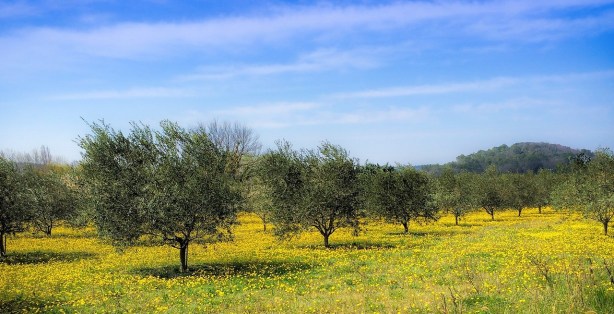
apple orchard

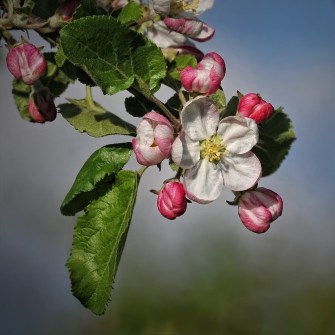
“Oh, the Lord is good to me,apple-blossom

And so I thank the Lord

For giving me the things I need

The sun, and the rain, and the apple seed.

The Lord is good to me.”

Amen, Amen, Amen, Amen, Amen.

Swedenborgian Hymn made famous by John Chapman called Johnny Appleseed.  (We used to sing it at church camp.)

I am a person given to reflection and spending time lost in my own thoughts. I love to take a cup of coffee and sit out on my  back porch.  A peace settles on me and life gets sorted out.  In my garden world, there is beauty, orderliness, and a stillness that yet contains the songs of birds, the beating of butterfly wings, and the busyness of bees. Life lessons are everywhere my eye rests.

apple coreHaving lost several friends lately to early deaths, I have found myself thinking about the meaning of life. Several weeks ago I was looking at some gardening quotes. One by Nelson Henderson has been sitting with me since then:

“The true meaning of life is planting trees under whose shade you do not expect to sit.”

As with most profound things this quote appears simple, so it is easy to be struck by it, then forget it.

Garden tree and fencelineYet, for me, thoughts like this stick around.  I cogitate, hang on to them, chewing them over for their meaning.  My first superficial thought was that I believe ecologically we need to plant trees to help our atmosphere.  I read once that if each person planted at least one tree, in its lifetime that tree would replace the oxygen you had used up living.
So, one of my gardening goals has been to plant trees in honor of all my family.  The twins and I planted a redbud for their tree.  I have two curly willows that I think of as representing our graceful granddaughters. In one shared plot, I planted a lovely lavender crepe myrtle for my mother, standing nearby it is a plum in honor of our daughter.  At the front, inviting you in, is a Japanese maple, short, strong and the guardian of the garden for our son…in law…and in our heart. I have an oak, tall and upright, I will plant this fall that will stand for our son, with a tulip tree for his wife. For me there’s a Japanese magnolia, my favorite tree, and finally, for Doug, there’s a fig (take that Adam and Eve!)

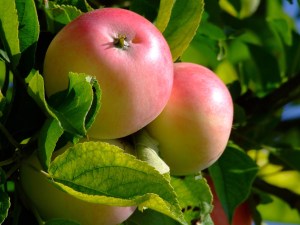
apples on the treeEveryone of them will outlive me.  A green legacy, I will leave behind someday, along with my garden, without knowing how they will fare.  And that’s ok.  It has been my job to plant them. It will someday be another’s job to tend them, and ultimately their fates are theirs (and in my view, God’s, the true master gardener.) Makes me wonder if any of Johnny Appleseed’s tees are still growing, or perhaps their offspring still providing apples…and cider.
I only know that I can’t be responsible for those outcomes, their tomorrows.  I can only control today. On this day, I can do what I can to contribute to making the world a little greener, a little better, while hoping that whoever sits underneath the shade of my trees, who picks the plums or the figs tomorrow, enjoys the fruits of my labor.

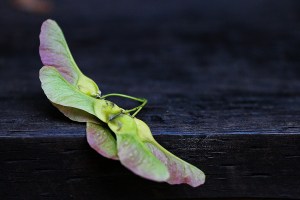
maple-seedWriting this, thinking about it all, reminded me of a quote I have always loved by a 5th Century Sankrit writer, poet, and sage:  “Yesterday is but a dream, and tomorrow only a vision, but today well lived makes every yesterday a dream of happiness, and every tomorrow a vision of hope.”

So these are my thoughts for today, along with a prayer that on this day you live well and fully.  May you sow seeds of wisdom for tomorrow, drink deep the joy of life in this moment, and hold a vision of hope in your heart for the future.

Posted in Writings by Wordsmiths and Others | Tagged , , , , , , , , , , , , , , | 2 Comments

Filling the Glass


Day 99 - Definitely HALF EMPTY :o|

Day 99 – Definitely HALF EMPTY :o| (Photo credit: uLightMe)

“I think I’m going to take my time,

                                                        life is too short

for immortality and its attendant disregards.

I have enough memories now for any weather,

either here or there.

                                                         I will take my time.

Tomorrow’s not what I’m looking forward to, or the next day.

My home isn’t here, but I doubt that it’s there either –

Empty and full have the same glass,

                                                                                                                 though neither shows you

                                                            the way. ”      

                                                          Charles Wright  Poet Laureate 2014

Charles Wright, our new Poet Laureate, shared this poem during a PBS interview I saw recently. While seeming a gentle man, Mr. Wright appeared more ordinary than I expected, bookish and bright, but more the next door neighbor you’d like to talk to than a celebrity, or poet of reknown. His thoughts felt like they could have grown in my own head and not felt like weeds.

It’s been a while since I have written here.  I think I am somewhat a creature of habit. For quite a while writing this blog was my way of being, but when I stopped during my husband’s recovery,  I fell out of the pattern.  Charles Wright’s sharing of his perspective on life and poetry jolted me back to thinking about things and wanting to share them.

English: Pinus nigra in Oxford Botanical Garde...

English: Pinus nigra in Oxford Botanical Garden. J.R.R. Tolkien loved this tree, and his last known photograph was taken at its foot. Français : Pin noir des jardins botaniques de l’université d’Oxford. J. R. R. Tolkien aimait particulièrement cet arbre. (Photo credit: Wikipedia)

I’m not sure when I felt in love with English, with poetry and prose.  I know reading became a way to understand the big things in life and the small.  Discussing the meanings behind works like Tennyson’s poem, In Memorium, or Faulkner’s novel, Light in August, as well as a lot of other literature in English classes in college, changed my thinking, shaped my choices, made me more me, as they helped clarify what I believed and why I believed it.

There are passages and quotes that stopped me in my tracks when, like one of Emerson’s sleepers on the train, I was headed in a thoughtless direction.  J.R.R. Tolkien‘s quote, “Many who live deserve death, and some who die deserve life. Can you give it to them? Then be not too eager to deal out death in judgement, fearing for your safety. Even the wise cannot see all ends.” was one such quote. It made me completely rethink my view on capital punishment. Other passages in other works simply made me think.

Wright’s poem and especially the line, “empty and full have the same glass but neither show you the way,” created another one of those philosophical pauses for me to think about life.

I loved Wright’s concepts on time in this poem, dealing with life’s end by taking our time; not getting so caught up in thoughts of immortality as to disregard the present.  I am intrigued that like Wordsworth in  Intimations of Immortality, Wright seems to allude to memories of here…..and of “heaven.”  Wordsworth says it like this:

“Our birth is but a sleep and a forgetting:

The Soul that rises with us, our life’s Star,

Hath had elsewhere its setting,

And cometh from afar:

Not in entire forgetfulness,

And not in utter nakedness,

But trailing clouds of glory do we come

From God, who is our home”

But Wright says his “…home isn’t here,” yet equally doubts “it’s there.” Ah, so the poet wants me to think, to question.  So… is the poet caught in the middle between here and there, a child of earth who has had glimpses of eternity?  Or like many of us, does he just believe in the now, love life, and just not want to leave it? Or is he wanting to be with God, but not wanting to leave family and friends?  Perhaps he is caught somewhere between “full of life” and “not yet quite empty of living?” Knowing that more of his time on earth lies behind, but not sure what waits ahead, unclear which way to go? Wright’s answer to these question is implied; it is a simple but good one:  Don’t live for tomorrow whatever it may bring, but live in the now, fully. Yet, also implied is that to fully live one must be touch with the eternal.

Blue Impact

Blue Impact (Photo credit: thefost)

For me, I believe it matters less about half-empty or half-full than what you do to fill your glass.  I think, for much of our life, we pour ourselves out into the lives of others, (our friends, our children,) and even into our work.  Often, we fill up with joy by doing that, but at other times it feels we are running near empty.

At least while we live, I think it is our job to find ways to refill the glass.  Certainly that requires knowing that unless we care for ourselves, attending to our physical, mental, and spiritual health, we can accomplish very little.  We do need to take a rest, live in the moment.  To paraphrase Walt Whitman, we need to take a walk in the wood, go to the beach and rediscover “the world in a grain of sand,” wander a meadow and “find heaven in a wildflower.”

Perhaps to reenergize, you need to listen to a concert, play with a child, pray or meditate, write or read, exercise or sleep.  Whatever it is, fill your cup anew so that you can pour yourself out and refill your cup, only to pour and fill again and again.  I toast the gift you give in doing that.

Posted in Writings by Wordsmiths and Others | Tagged , , , , , , , , , , , , , , , | 5 Comments

A Lesson on Writing, Gardening, and Life from Maya Angelou


Thorns Over Roses

Thorns Over Roses (Photo credit: Moose Winans)

“The thorn from the bush one has planted, nourished, and pruned pricks more deeply and draws more blood.”  Maya Angelou

Sometimes, I find it interesting that I began to write again at the same time I started to garden. Perhaps, this is a stage in life. Perhaps having launched our children into adulthood, my biological clock refused to stop ticking. Something in me found creativity imperative. No longer restricted to gestation, words and seeds rioted from me, so I kept planting, writing, and watching my “babies” proliferate.

Yet, a beginner mistake for gardeners is to want to fill every space with plants, leaving no room for the growth that will come. Soon things run wild and out of control. Even  for me, at this stage having taken a Master Gardener‘ Course, it’s not always easy to hold the fine line between lush and overgrown. A beginner mistake for a writer is to assume every word that is written is written in stone, and it so easy to fall in love with our language we drown our readers with words.

dragonfly on pansiesTo put it kindly, I used to be a “live and let live” gardener. A growing plant seemed like a healthy plant  which, of course, is not necessarily true.  Branches can crisscross as they develop, rubbing the branch next to them every time the wind blows, opening a path to disease. And as they push out crowds of leaves to collect every ray of sunshine, they can block light and even air from reaching the interior of the plant, slowly stifling it.

Pushing life to the max, as we can so easily do, can do the same to us, destroying the very thing we are trying to create.

pruning-shears copyOne of the elements of gardening I have learned to embrace is the art of pruning. Growth, unrestrained, can lead to death.Pruning, cutting back branches or commitments, opens things up and encourages healthy development. It eliminates the duplicative, the superfluous, and helps us focus our thoughts and energies.  It is a writing lesson for the need to edit. It is a life lesson on letting go of things that keep us busy but no longer make us happy, on the need to eliminate any unnecessary burden that weighs us down.
Ask any gardener, any cancer patient. Growth managed  makes a bonsai beautiful and harvests bountiful. Just as editing can make the difference between having a manuscript or a masterpiece, living a focused life can create meaning and joy from what is otherwise only existence.

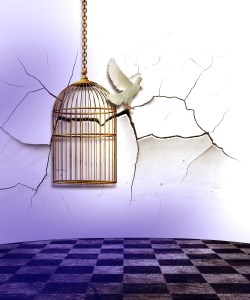
Freed birdThis week an amazing woman burst from the cage of the earth.  Talented in so many ways, Maya Angelou knew how to hone her words, to draw us word pictures, to sing to our souls of trees and rivers and rocks, to prick our consciences and our hearts, to challenge us to leave behind racism, sexism, and bigotry and embrace each other with compassion, putting down roots that can give birth to dreams.

Poetry and prose were the finely tuned instruments she wielded to change the world.  A fading ember, she banked her fires and flamed on, targeting ever so precisely what needed to burn.

Fly free, Maya! Rise. May we all prune, and prick, and find our focus, following where you lead.

Enhanced by Zemanta
Posted in Writings by Wordsmiths and Others | Tagged , , , , , , , , , , , , , | Leave a comment

Patience in Light and Shade – A Lesson From My Garden


Virginia Sweetspire

Virginia Sweetspire (Photo credit: dermoidhome)

“A man has made a start at least on understanding the meaning of human life when he plants shade trees under which he knows full well he will never sit.” D. Elton Trueblood

Yesterday was perfect. It was a day made for Goldilocks: not too hot, not too cold, a sunny day after a day with lots of rain. On this ideal day to garden, I lugged 9 bags of mulch and 6 bags of dirt from the nursery and planted a Swamp Hibiscus and a Virginia Sweetspire bush. I staked a fig tree that grew two feet last year and, top-heavy in yesterday’s rain, decided to tip over. Then, I got flowers into the 4 big planters for my porch steps and carted them out front. By five o’clock three bags of mulch had been distributed around the two new shrubs and one of my flower beds. Tired, and muscles complaining a bit, I swept my potter’s bench, sighed, and sat down content on my back porch. Yesterday was perfect.

English: Porch with rocking chairs at the Colu...

English: Porch with rocking chairs at the Columbia, North Carolina – Scuppernong visitor center – 2003 (Photo credit: Wikipedia)

When we came to Edenton six years ago, we found the old restored houses all around us to be charming.  To walk near the water in the historic district of what was one of the earliest colonial capitals carried us back in time. It seemed a less complicated state of being, a place where big wide porches invite you to sit down in a rocker and drink a companionable glass of sweet tea with a neighbor.

Equally enchanting were the historic gardens.  English cottage gardens making small spaces captivating, or formal grounds, organized beds of flowers often edged in boxwood or other trimmed shrubs, reached into my spirit and sang of peace.  I could picture ladies with hooped skirts and parasols strolling the grounds with gentlemen in elegant suits, in hats and spats.

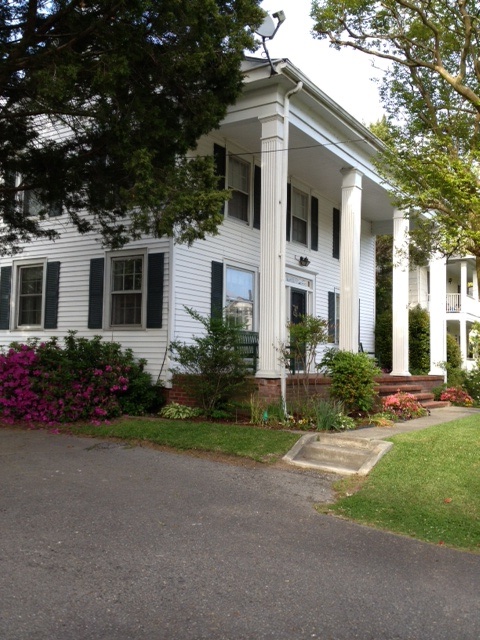
Front of house and flowersOur beautiful Georgian house was lovely but our very large backyard had none of this charm.

Here almost nothing was planted. The last occupant had obviously thought to make an improvement and had added a bin for a water garden. I’m not sure what interrupted her plan but the bin sat bereft and forlorn, occupied by lilies, but nothing else. Two lonely gardenia, a couple of  large camelias against a small part of the fence, and the lilies in the stark rimmed black bin were it.

Where to begin? Just looking at it seemed daunting. I knew nothing about Southern plants, (including the gardenia) and our backyard faced North. It also had a number of trees adding to the northern shade. It was not going to be easy, and given it’s size I knew it would take a while.

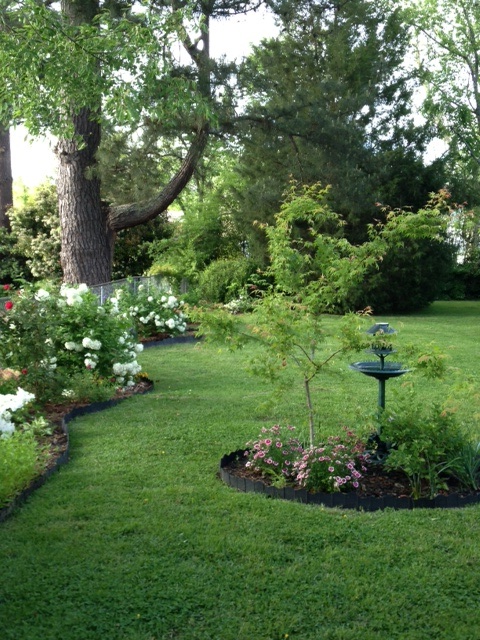
Garden best view of fencelineIt has. And I have learned a lot in the process of transforming it. My first lesson was patience. Rome really wasn’t built in a day, and I failed at a number of things, tried trees in several spots that died, lavender that shriveled in the sun, and a hydrangea I had to move from the front yard to the back to save it from a similar fate. Learning comes at a cost sometimes.

The long fence between our yard and the church parking lot on the left has been edged on both sides now. Snowball bushes, knock-out roses, canna lilies, multiple azaleas, hydrangea, clumps of iris, daisies, burning bush, a new forsythia, day lily, mallow rose, aconite, columbine, coreopsis, and a scuppernong grape vine have joined the one gardenia. Six other garden beds in various spots have added depth and points of interest like the fairy garden around the crepe myrtle. Ah, and the stark black bin, abandoned and on its own, has been surrounded by a Japanese magnolia tree, peonies, calla lilies, lavender, Shasta daisies and more.

I have found a variety of lilac that can survive the heat and received gifts of native Southern plants from gracious friends. For trees, I added  a dogwood, (now 5 feet, “Fifi” grew from a 6 inch twig someone gave me), a plum, a fig, two curly willow, a redbud and a tulip tree. I have dug and planted everything myself.  I tell the doctor it is my exercise. Digging out the turf of St. Augustine grass has been back-breaking…and gratifying. Good for my heart and my soul.

yard and gardensI have learned to watch, to really love the shade that protects from the hot afternoon sunlight. I have come to see that different times bring different subtleties of light, and that there is light in the midst of shadow. It moves in streaks from the East of the garden in the early morning, to bright overhead for my sun-loving plants, to golden afternoon shafts reaching even the deeper spots dappling them with gentle light, so that  my bleeding heart is flourishing. Patiently observing this interplay of light, taking time to find the best spot for each plant, has been a key to success in gardening like it is in life.

Most important, I have discovered that watering less frequently but deeper is best. It creates deeper roots, just like a rarer but real compliment means more than faint and constant praise in the mind of a child.

Light and shade, work and rest, growing mighty trees from tiny sticks, everything has its season, and all of it, all of it, in its own time is “just right.”

Enhanced by Zemanta
Posted in Writings by Wordsmiths and Others | Tagged , , , , , , , , , , , , | 4 Comments

Points of View – On Managing More Than One


English: Looking stunning as always

English: Looking stunning as always (Photo credit: Wikipedia)

“When you really listen to another person from their point of view, and reflect back to them that understanding, it’s like giving them emotional oxygen.” Stephen Covey

“There is nothing insignificant in the world. It all depends on the point of view.” Goethe

I’ve told you that in September I was able to talk to an agent who did a critique of the first ten pages of my novel. Much of our discussion was on point of view, which has triggered a lot of thinking and learning on my part.

Point of view has always intrigued me. As someone who’s been a therapist, I’ve learned a lot about entering into the perspective of another. That is a critical skill for helping an individual, couple or family make changes in their life/lives. You have to join them where they are, in order to help create a map for how to get to where they want to go.

Covey’s quote is a duplication of my experience. Individuals suffer when they don’t feel heard, and for couples (or friends, or colleagues) failing to listen fractures the relationship. So, slowing down the communication, getting each to listen and “reflect back understanding,” as Covey says, can be healing.

The KEY to this is: To really understand other’s point of view, you have to stop asserting your own. That’s the hardest thing anyone can do. Why? Because typically we only half listen, busy marshaling our rebuttals, hearing our own viewpoint echoing in our ears.

But if you want to listen, instead of making a statement back, you ask a deeper question. Probe. Really try to understand and ask questions until you do.  If you do, it gives the other person the chance to do the same. It’s not hard, but it takes work. I have known all this from my therapy practice. So, what did I learn? That writing is a lot like therapy: who speaks and who listens are important questions.

English: An apple.

English: An apple. (Photo credit: Wikipedia)

These days the hottest selling books are written from one point of view.  One character, usually the “I” of their own story, tells it to you. The only point of view is theirs. Some like this style because it assures the reader will identify with the teller of the story. We become Bella. We love Edward…well a few of us love Jacob.

What is difficult (or not achieved) using first person narrative, is how to create a deeper understanding of the other characters. Show don’t tell dialogue alone is often not enough to demonstrate motivation or doubt, and many characters, especially the villains, in some surprising best-selling books can seem pretty one dimensional.

At any rate, the agent who read my opening pages told me that she wouldn’t represent stories from more than one point of view.  She cautioned me strongly not to have more than two, and the true kiss of death, she warned, is an omniscient narrator.

The crazy thing is that I enjoy multiple points of view. I love free ranging discussion, brainstorming sessions, the interchange of ideas. And I have always enjoyed knowing the inner workings of more than one character as well as observations on other characters by those close to them. I relish complexity. I want to hear more than one take on where things stand, wrestle with difference, strike a balance.

The eponymous Fellowship from left to right: (...

The eponymous Fellowship from left to right: (Top row) Aragorn, Gandalf, Legolas, Boromir, (bottom row) Sam, Frodo, Merry, Pippin, Gimli. (Photo credit: Wikipedia)

In my favorite fantasies, multiple volumes with many characters, I think having only one viewpoint would be restricting.  Do we only want to know what Frodo thinks, or Sam?  What about Gandalf and Aragorn? Don’t scenes with Gollum bring us into the story?

My novel, an interplay of historical fiction and folklore fantasy, contains a number of complex characters. The Call tells a coming of age story of a young girl, Lis, who is not the simple healer she believes herself to be. This story is set against a backdrop of political intrigue true to that time (1446 Poland) during a contest for who will be king. If there were only one viewpoint it would have to be Lis’. Yet in the grand scope of my book, her choices not only impact herself, her family and her friends, but also her country.  To do this all justice really requires several characters to help carry the plot line, and these characters have choices to make as well.

English: Points of View, by Tony Cragg, Málaga...

English: Points of View, by Tony Cragg, Málaga, Spain. (Photo credit: Wikipedia)

So, I realized that I had to find a way to solve this problem. One point of view or many? IF more than one, then how to manage them? I decided on delineated scenes carried by one character’s viewpoint at a time to solve the problem of confusion…and to still keep multiple points of view. What I hope is this allows my reader the chance to identify with more than one character.

The other thing acheived is that it allows scenes in which my villains express their thoughts.  They may still be wrong, even evil, but at least some of their choices can be understood. I think it makes them deeper, multi-faceted, and the possible choice to follow them and choose evil more understandable. To me, like to Goethe, that is not insignificant – every point of view, however skewed, has meaning.

Of course, while I have made the choice of who gets to speak, it remains to be seen if anyone will….listen.

Enhanced by Zemanta
Posted in Inklings | Tagged , , , , , , , , , , , , , , | Leave a comment