Finding Angels – On The Christmas Crèche


photo-27

To the manger of Bethlehem come,
                                                                                             To the Saviour Emmanuel’s home;
                                                                                            The heav’nly hosts above are singing,
                                                                                        Set the Christmas bells a-ringing,
                                                                                           Lord, have pity and mercy on me!                                                                                            Come, come, come to the manger,
                                                                                   Children, come to the children’s King;
                                                                                   Sing, sing, chorus of angels,
                                                                                                      Star of morning, o’er Bethlehem sing                                                                                             – from the traditional Christmas Carol

The background to this post is this was a grueling week. Our students have been trying to complete their GEDs before the end of this semester because, come January, the tests will change. Not only will they be harder, but if a student hasn’t completed all the tests, the ones he has passed will no longer count. So, five times as many students tested Wednesday as is typical, and the pressure feels enormous. There is one week left and the last test on our campus is this Wednesday, for many their last chance to graduate.

On the home front, Friday we traveled to Raleigh so that Doug could consult with an ENT specialist, who confirmed he will fairly quickly need surgery. She was concerned enough to get us an appointment with a Duke throat surgeon first thing on Monday. So a tough week on all counts.

Being a social worker at heart, though my faith is very central to who I am, I try to write my posts respecting all perspectives, even the choice of non-belief. But this post comes with a disclaimer, this is a post about my husband, and it is also a story about faith.

photo-17Doug is a pastor. He’s not the kind that has you call him by that title, or any title. He prefers to be called simply, Doug. I think part of that is because he wants to be real, to have a genuine relationship with all those he meets, and not have the stereotypes about clergy stand between him and creating a caring relationship. He is a very human and humane man. He is also someone whom God called to serve here in Edenton and that leads me to the story.

When we were getting ready to move here, our daughter worked in customer relations for a construction company. Gretchen has a fondness for the elderly and having worked for a senior care organization, a real gift with them. One of her clients was building a home with space for her father, and Gretchen and he connected. In the course of one conversation, she told this gentleman that her father was moving to North Carolina to come to a new church. His response was a gift and a Christmas blessing.

The man was a German immigrant and woodworker. He told Gretchen that he would be giving up carpentry when he moved to his daughter’s new home. He explained he had just enough materials for one last project, and said he would like to make something for Doug’s new church, then he asked if the church had a crèche. Doug checked, and surprisingly, it didn’t.

Focused on the move, we thought little of the gift, not knowing what to expect. We spent that summer packing. He spent it crafting a magnificent gift.
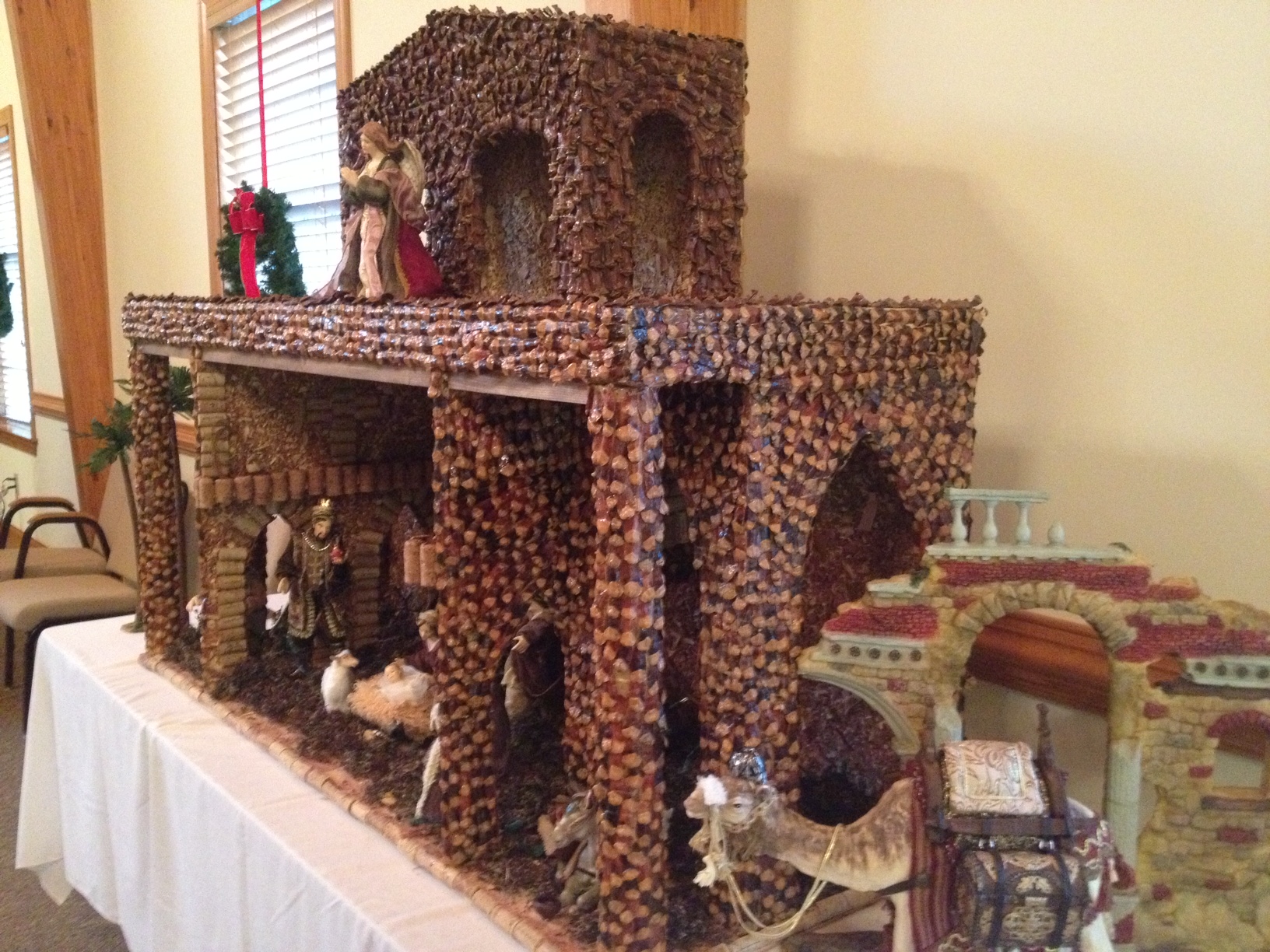
photo-19More than five feet wide and two feet tall, this two-story stable is not delicate, but heavy and sturdy. The inside is rough, the outside is thatched in the bracts of Longleaf Pine cones, layered one on top of another, glued individually. I can’t even imagine how many. They are sharp to the touch. There are three rooms in the main stable and one above. Rough shelves line the walls in the main room. The floor is covered in dried seaweed. Like the stable in which Christ was born, there is rudeness, yet a simple beauty.

photo-21Of course, without the family, the baby, the Kings, the shepherds, this would only be a stable. So the gift included finely made porcelain figurines, dressed in cloth, homespun for the family and shepherd, elegant and ornate brocade for an angel and the kings, their robes embroidered and trimmed in gold braid, with finely crafted gifts. There’s a rough wooden stave for Joseph, woven bags and baskets for the shepherd and donkey, tassels and damask cloth adorning the camel, feather tipped palm trees and a straw filled manger, all stunning in their splendor.

photo-24The gift of a stranger.  His last crèche. Where can anyone find appropriate words of thanks for a gift like that? But as I type those words, I can only think, how fitting. Where can anyone find words of suitable gratitude for the gift behind this gift, the babe lying in the straw, the gift of hope to the world, the true blessing of Christmas?

This week was the second Sunday of Advent. Its theme is hope, hope that came to a dark world in a dark time, hope that was born into a raw setting. Awaited, but unexpected in purpose, hope designed according to a plan we human beings barely grasp. Celebrated by angels, visited by kings who kept him secret but proclaimed by common shepherds, unvarnished hope was born, the kind of hope that stands in the face of anything.

Do you find yourself in need of it? I do. I need to follow the star with the kings. I need to listen to the songs of the angels and go looking for the baby with the shepherds. I need to come to the manger of Bethlehem and say Lord, have pity on me, on my students, on your servant, Doug, on the flock that is my family.

And when I reach that stable, I want to remember a man who had one last crèche for a church he never saw and a man he never met. That is what hope is. It is reaching out in faith because you feel a call to do so. It is giving one last gift. It is belief that God is guiding you and will always lead you to your destination, a star to guide you, angels waiting to welcome you. Home.

Posted in Writings by Wordsmiths and Others | Tagged , , , , , , , , , , | 2 Comments

On Tradition – How the Past Touches The Future


Thanksgiving Turkey

Thanksgiving Turkey (Photo credit: OnTask)

Family traditions counter alienation and they help us define who we are; they provide something steady, safe, and reliable in a confusing world.” Susan Lieberman in New Traditions

Tradition comes from the Latin word, tradere, meaning to transmit, to hand over, or to give over for safekeeping. One definition calls it the passing on of customs and beliefs from generation to generation. Someone said that parents should give their children roots and wings. Traditions live in the roots. They are made up of memories of sights and sounds, of tastes and smells, bound together by love.

Ella and Grey, our twin grandchildren, have recently been exploring their roots, doing a project for school on their family. One part required an interview with “Boppa and Nana” about our childhood, how it was the same or different from theirs. They needed the names of their family going back to our parents and the names of every place we had ever lived.

Each of them is creating a personal scrapbook to which they can add school pictures, mementos from baseball and soccer, souvenirs from prom and college. One day, they can share it with their children and grandchildren. And there at the beginning will be their connection to Boppa and Nana. That means the world to me.

Wednesday, Ella and I grew the roots a little deeper, baking pumpkin pies from my mother’s recipe. As we added the cinnamon and nutmeg, the ginger and cloves, I whispered in her ear that one day, when she baked it with her grandchild, I hoped she would remember me and how much I loved her.

Thursday, Ella and Grey broke up the bread for Grammie’s stuffing just like their mother and uncle did when they were children, just like my sister and I did when we were kids. Ties to the past are roots that grow deep, like the hunger that builds while the turkey roasts and flavors the air.

As a gardener, however, I know that not all roots have to be kept. Plants can get pot-bound, need new soil, or have to be transplanted to grow strong. Roots are intended to give nourishment and enable growth, but not to become so rigid they preclude wings. We all need to shape and reshape ourselves, to take from the past and carry on what keeps us grounded, but not earth-bound.

Thanksgiving

Thanksgiving (Photo credit: The Consortium)

That’s why each generation chooses which traditions to keep and adds some new ideas of their own. For this Thanksgiving, Grey, Ella and I made a pumpkin cheesecake and an Ina Garten apple pie. Then, as we ate Honey Crisp apple slices, we enjoyed the spicy scents of a new tradition coming from the oven.

Christmas is less than four weeks away and will bring its own family traditions. Stockings will be hung at both of our children’s homes, like they were at our house. Trees will be decorated…..and a new tradition, Jack, the elf, will appear to keep watch for Santa and assure the kids are nice, instead of naughty, as they count down to Christmas. Each night he will move and the day will start with a look for where Jack is now. What a smart and fun replacement for the paper chains we had for our kids.

At Chris’ house an angel looks down from on high. At Gretchen’s, a star shines from the treetop, lit in red like the one she grew up with, the one that originally topped my family’s tree. Recently, I learned of roots that link that star to a Polish tradition that sends the youngest child to watch for the first star in the sky on Christmas Eve which, when seen, begins the festivities. My grandparents in Poland must have watched for that star with such expectation.  In my childhood, our star seemed wondrous and peaceful, as if it blessed us as I stared at it in fascination.

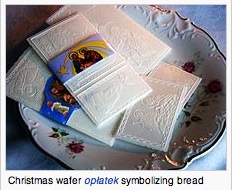
OplatekGretchen is also renewing the tradition of oplatek wafers at Christmas Eve dinner. My mother always brought them to us from the Broadway Market and each family member would share theirs and take a piece from everyone else, creating a family communion. That Gretchen went on a search to find what our kids called “the paper” touches my heart and reminds me of how my mother loved this custom.

Will Ella and Grey follow every tradition? Will Caroline and Catherine? Probably not, but I hope some roots will remain to keep them linked to me and Boppa, to Grammie and my family, to Nan and Grams, Doug’s paternal grandmother, who gave him his Christmas stocking. Whatever they choose from their roots and add to with their wings will be the past touching the future, wrapped carefully and kept stored for generations yet to come.

I hope yours was a blessed Thanksgiving…and that in the weeks ahead during the advent season you are filled with warm memories of family celebrations, the smells of evergreen and Christmas cookies, and the sounds of carols and angels filling the night.

Posted in Writings by Wordsmiths and Others | Tagged , , , , , , , , , , , , , | 5 Comments

Following Bobbie – On What Our “General” Taught Us


11 - Behind the Shield

“God loves with great love the man (the woman) whose heart is bursting with a passion for the impossible.”  William Booth

In an era where even today 35% prefer male bosses over 23% who prefer women, I found the best and wisest woman boss in Roberta C. Schofield when I started working for The Salvation Army in 1982.

Bobbie, who holds a BS and MSW degree from Syracuse University, ABD there at the Maxwell school, fostered professionalism and saw to it that almost all of the leaders she hired, predominately women, also completed their “MSWs” or other advanced degrees. I finished mine in 1987.

But completing our degrees wasn’t the best part of our education, that came in watching and listening to Bobbie. B. J. Gallagher, noted writer on women in leadership, said at a conference, “Everyone in this room is a teacher.”  That was quintessentially Bobbie. She was a real leader, not only “talking the talk” but “walking the walk” and we all learned by following her path, hopefully adding our own footsteps to hers.

One of the “Bobbie stories” that was foundational for me and many others happened in connection to the Emergency Shelter. Bobbie’s office was just a short walk down the hall from it and one night, when she was working late, a shelter resident wandered down in her direction. Seeing her sitting at her desk, but not knowing who Bobbie was, the client told her toilet paper was needed in the women’s restroom. Bobbie immediately got up and got it. That became a social work lesson and standard. At Syracuse Area Services we “all carried the toilet paper” to wherever there was a need.

Bobbie loved aphorisms. When she retired, every table at her farewell dinner was decorated with Bobbieisms. “Don’t trade your brains for a ham sandwich.” “No one gets to say ‘that’s not my job.’ ” We all contributed our favorites. Probably the one standard that resonated the most for me was “That and better will do.” I tried to hold myself to it, Bobbie was a living example. There was always some unserved corner of the community to reach out to embrace:  Street kids, parenting teens, mentally ill women, kids in trouble with the law, families who needed food, or daycare, or parenting support, the elderly who needed a meal and a loving touch. If a program didn’t exist, we’d create one and figure out how to fund it. Can’t come to our office? No problem. Bobbie’s troops fanned out through the city and came to you.

By 2002 when she retired, she had built up “the Army” in Syracuse from the more typical small service organization to one of the largest, with  a multi-million dollar budget and over 300 staff serving in programs throughout the city. People have always asked me how she did it. She would no doubt say, I didn’t do it alone, and while that was certainly true, I always answered by saying that when Bobbie couldn’t do everything by herself, she collected great staff and inspired them by example, and then partnered with her Board and the community to make it happen.

Of course, once it did, she kept up the standard of that and better will do. “How can we make this more client friendly, more in keeping with the love of God?” were questions she asked herself and her staff. It didn’t matter how big or small the detail of service, continuous quality improvement prevailed. Bobbie had learned from her father William E. Chamberlain, a Salvation Army National Commander, that respect for people had to be an abiding principle.

ZoomedIn gives a great example saying that at a Salvation Army Territorial Conference Bobbie said, “Look at the signs in your place and ask yourselves, ‘What are they telling your people?’ ” she said to the delegates. “Do they say that you love them? That you’re going to serve them in a professional way that is going to be respectful and maintain their dignity?”

Not unexpectedly, Bobbie became one of the most powerful women leaders in Syracuse, and was described by one Board Member as an exec who could have led any of the Fortune 500 companies in the nation. ZoomedIn describes her as “well–versed on the socio–economics and demographics of ‘The Big Little Town’ of Syracuse.” And they credited her by noting, “During her tenure as Area Services Executive Director, she developed credibility by integrating Salvation Army services into the language and culture of the community.” Absolutely true. I would add she mentored and modeled not only at the agency she loved and grew,  but by her leadership on the “PresExs” group where she paid special attention to nurturing new women executives from other community agencies.

William Booth (1829–1912), founder of the Salv...

William Booth (1829–1912), founder of the Salvation Army (Photo credit: Wikipedia)

The most complimentary thing I can say about Bobbie is that she lived this quote by William Booth: “While women weep, as they do now, I’ll fight; while little children go hungry, as they do now, I’ll fight; while men go to prison, in and out, in and out, as they do now, I’ll fight; while there is a drunkard left, while there is a poor lost girl upon the streets, while there remains one dark soul without the light of God, I’ll fight – I’ll fight to the very end!”

When I went to work at The Salvation Army I was looking to live out my call and create a ministry for myself, to find a place to “Dream the Impossible Dream.” I found a similar vision in Bobbie, in the leaders she recruited, like Linda Wright, Diana Stanley, Pauline Sharp, Tom Knox, and Linda Lopez, and in those I hired who worked with me in Family Services. Together we fought the fight, and fighting together created many possibilities from the impossible.

Thank you, Bobbie, for all you taught me and so many others. You may not remember it but once I told you that you were my general and I would march anywhere you sent me. Now we march in different places, but you still inspire me every day to put “Others” before self. It has changed my life.

Want to know more about Syracuse Area Services follow this link: http://www.use.salvationarmy.org/USE/www_use_SyracuseNewYork.nsf/

Posted in Writings by Wordsmiths and Others | Tagged , , , , , , , , , , | 2 Comments

Following Miss Hassett – On What Older Women Teach Us


Eleanor Roosevelt at 15

Eleanor Roosevelt at 15 (Photo credit: Wikipedia)

“Just as young people absorb all kinds of messages from the media, young girls learn what it means to be a woman by watching the older women in their lives.” Carre Otis

“In the long run, we shape ourselves, and we shape our lives. The process never ends until we die. And the choices we make are…our responsibility.” Eleanor Roosevelt   To this I would add, “…and our heritage and legacy.”

I have known many amazing older women, great women, whose lives and how they shaped them challenged me to become like them.

My first example was Miss Hassett. She was our housekeeper when I was growing up. I never thought of her as a nanny or babysitter, and certainly not as any kind of employee or servant. She was MISS Hassett, strong woman, force of nature, interested in the bits and pieces of nature I brought into the house, someone who treated me with respect even though I was a child.

Miss Hassett did not dole out hugs or kisses, although she regularly bandaged my skinned knees, made the best fudge in the entire world, and read to me while I leaned against her warm strong body. Everything was done efficiently with little “fuss and bother,” one of the phrases she would use with me when I was upset, as in “there’s no reason for such fuss and bother” and “Yes, Miss Hassett,” I would reply as she handed me a tissue to wipe my tears.” Then with a small smile, she would say, “It’ll be fine.” I believed her.

She was an Englishwoman, short, sturdily built, with a straight-cut shock of short, thick, salt and pepper hair that changed to white over the years she worked for us. She had been a teacher and had retired (mandatorily, I think) when she reached sixty-five. In those days, this did not provide enough to live on. Single and childless, Miss Hassett just stoically took a job with my family and “got on with it.” (Another quote and piece of her wise advice.)

Initially, she “lived in” during the week. Later, as my sister and I grew older, she arrived by bus at 8:00 (after my parents left at 7:00), to make us cinnamon toast and assure we got off to school. While we were gone she would vacuum and clean, iron and mend. When we got home, she’d have a snack for us, sometimes her creamy, buttery fudge.

Miss Hassett believed in “outdoor time” and would send us out to play. When we brought home clay from the creek, she taught us to make a pinch pot, and helped me paint mine.  Once, deep in the woods behind our house, we discovered a long-abandoned farm that had over-run blackberry bushes filled with plump fruit. We ran back to tell her about them and she grabbed a bucket and came to help us pick them. We ate the blackberries with cream, nursing the scratches on our arms. I adored her. Miss Hassett taught me independence, self-sufficiency, and a love for exploration.

Later, Nan, my husband’s grandmother, would become my role-model of what a Nana should be like, as she enveloped me into my new family and told me stories about them and her husband, whom she sometimes called, “the boyfriend.” Then she would ask me about Doug, “Did the boyfriend call?” I felt like he was a legacy and she was passing a torch.

I have vivid recollections of her, the best were the times she held our children as babies. Her joy in them lit up her eyes and folded her rosy apple cheeks into fine lines as she smiled down and rocked them, holding them as if they were the greatest gift. “Oh, what a smart young lad you’ll be,” she said to our son. “My, you have the loveliest and biggest eyes I have ever seen,” she cooed to our daughter.

Afternoon Tea

Afternoon Tea (Photo credit: su-lin)

Nan helped me sew the dress I wore to our rehearsal dinner, all the while admiring “how clever” I was making it. Interestingly, she, too, was an Englishwoman, her mother an immigrant like my grandparents. The summer before we got married I lived with her. She made afternoon tea for me and Doug’s sister and baked us each “one chocolate chip cookie” the size of a small cake, like she did for Doug, who lived with her during the school year.

Since these ladies left my life, I have found other older women to learn from, many “great ladies of the church,” in addition to my own mother (about whose wisdom I have written many posts), and strong women leaders, old and young, at the agency where I worked in Syracuse.  All of them had wise thoughts to share and have served as examples of strength, organization, kindness, faith, charity, and integrity.  All have also been no-nonsense women whom I admire and strive to model myself upon.

I believe that part of walking in their footsteps is deepening the path for other women, creating a roadmap, I hope, for my daughter and granddaughters that they will pass on to generations yet to come. So here’s to Miss Hassett and Nan and Mom and all the women upon whose shoulders I stand. You live forever in my life and in my memory.


Posted in Writings by Wordsmiths and Others | Tagged , , , , , , , | 6 Comments

True Grit – On Being Successful


English: The head of a wild tortoise in Cape P...

English: The head of a wild tortoise in Cape Province, South Africa (Photo credit: Wikipedia)

“Success is the result of perfection, hard work, learning from failure, loyalty and persistence.” Colin Powell

“Nothing in this world can take the place of persistence. Talent will not: nothing is more common than unsuccessful men with talent. Genius will not: unrewarded genius is almost a proverb. Education will not: the world is full of educated derelicts. Persistence and determination alone are omnipotent.”  Calvin Coolidge

Last Sunday on NPR, I listened to an overview of a Ted Talk highlighting the work of  Angela Duckworth, who has studied success and its co-relation to what she calls “grit.”  She defines grit as “sticking with things over the long-term until you master them.” Basically, her theory is refusing to give up is what leads to success.

Before she became a psychology professor at the University of Pennsylvania, Dr. Duckworth taught math in junior high and high school.  In what would seem, on the face of it, to be somewhat self-evident, she saw that her most successful students were not necessarily her brightest or most naturally gifted students, but it was the students who tried the hardest who succeeded.

She came to believe intelligence could be an aid to success, but in some instances could stand in the way. Some of her smartest students, acclimated to easy or effortless achievement, would give up when mastery or success proved difficult, even more so if they experienced actual failure. That is when she began to develop her concept of grit. Like most good scholars, she went on a search of the literature and found lots of research measuring a positive connection between IQ and success, but little on links of success to persistence, determination, or just plain stick-to-it-tiveness.

So she began a study of students at Ivy League schools and learned that it was the grittiest students, not the brightest, who had the highest grade averages (GPAs). “The gritty individual, ” she writes, “sees success as a marathon. Their advantage is stamina.”

The analogy which springs to my mind is Aesop’s tale of the Tortoise and the Hare.  Apparently, it is not just in the woods that slow and steady wins the race.

The context for me is two-fold.  First, during my high school career, despite being a good student and having, what I’d like to think, are a good set of brains, I hit a class where I struggled.  In Honors Math 11, nothing made sense to me. It was my first experience of failure. It didn’t help that my teacher’s way of dealing with this was to humiliate me for my “not getting it” as a way to shame me into doing better.

Yet, I got a 96 on the final Regents exam at the end of the year because I found a way to succeed. I realized I couldn’t learn from my Math 11 teacher so I went back to my 9th grade Algebra teacher and asked for help. I stayed after school for her every day until the proofs finally clicked for me and made sense.  Yet, learning the Math was not the most important thing that happened in the long run. What really mattered was I learned the life lesson that if I refused to quit, I could wrestle failure into success.

Currently, my interest in this is that I still haven’t heard from the agent to whom I sent my query letter and the pages he requested when I pitched him.  It’s almost two weeks, though it feels like a lifetime when I check my email, and I know it can take a lot longer.

I am not giving up. And if he doesn’t want to be my agent, I will find someone who will.

I always loved the quote attributed to Churchill that England was like the English bulldog, whose nose was slanted backward so that it could breathe without letting go.  I may not be English but once I sink my teeth into something, like I did with Math 11, I don’t let go easily. One of my mottos in life is: “The only one who can make you fail is you.”

On a University of Pennsylvania webpage, Angela Duckworth has a “grit test.” On a scale of 1 – 5 with 5 as the grittiest, I got  a 4.5. Maybe that is no surprise: I am at a gritty point in my life.  (How gritty are you feeling? Want to take the test?  Just clink on this link:)   https://sasupenn.qualtrics.com/SE/SID=SV_06f6QSOS2pZW9qR&SaveButton=1&SSID=SS_5b51rJR5kZ69EmV

So how gritty are you? Feeling determined at this moment?  I hope so!  I don’t know what you want to succeed at, but I say:  Turtles of the world unit. Let’s go get that “bwasted wabbit.”

Posted in Inklings | Tagged , , , , , , , , , , , , , , , | Leave a comment

Living Your Dream in Short Time


Time

Time (Photo credit: Moyan_Brenn)

“A positive attitude is not going to save you. What it’s going to do, everyday, between now and when you die, whether that is a short time from now or a long time from now, everyday you are going to actually live.” Elizabeth Edwards

“God hath given man but a short time here upon the earth. Yet upon that time depends eternity.” Jeremy Taylor

“Dream as if you would live forever. Live as if you would die tomorrow.” James Dean

While it would be impossible to actually focus on our own dying all the time, regardless of which end of 50 we are, we never know how much “alotted time” we have. Yet, somehow, we all act as if it would be forever.

My husband and I are in the North for a funeral. Within the last three months, two friends have lost spouses.  While both of these couples were older, it has led me to think something I have certainly thought before:  Don’t wait. Live in the present, but do your dream now, not tomorrow. Don’t put it off. Just do it, whatever it is.

I have seen way too many people who have dreams they never pursue. They want to change jobs, or change careers, or go back to school, have a child, or move, or write a book, and they don’t. For those who make the change, I have heard countless times, “Why did I wait so long?” Others, after years or decades of dreams delayed, finally decided to move forward, only to find the struggle to change unbearably difficult, or the opportunity lost.

The crazy thing is despite having seen all that, the thought of living as if I needed to accomplish what I want to accomplish now, before it’s too late, before I die, or the chance has passed me by, is hard to hang on to.  The inertia of living sucks at me, relentless in its demands.

When I was a child procrastinating over a task, to get me started my mother would say, “There’s no time like the present.”  Now, as I think about it, I know there is no time but the present. Someday or tomorrow are non-existent until they become today, and even today exists in short time, a blink of the eye.

So, for me, today, I need to get started on book two, or send out one more query on book one. I will do one thing at least to advance my dream.  How about you?

Posted in Writings by Wordsmiths and Others | Tagged , , , , , , | Leave a comment

Query – Would you buy this book?


Continue reading

Posted in Writings by Wordsmiths and Others | Tagged , , , , , , , , , , , , , , , , | 2 Comments

I’d Rather Be Right Than President – To be published or to self-publish


Published!

Published! (Photo credit: JoshuaDavisPhotography)

“I’d rather be right than president.” Henry Clay

Ok, this is for history buffs: do you remember learning about Henry Clay?  Believe it or not, I do.  This quote stands out in sharp contrast to me because Clay was known as the “great compromiser.” He held off the conflict between the North and South over slavery for years by helping people find middle ground. Yet, when told he should moderate his views on slavery and federalism if he wanted to become president, Clay made this famous statement. This highly regarded legislator, one of the youngest Speakers of the House, lost the presidential election four times. His election required a compromise he could not make.  This brings me to another lesson from the Hampton Roads Writers Conference:

Writing (and Life) Lesson 2: To Try to Publish or to Self-Publish, To Compromise or Not to Compromise

When I began to get serious about being published, I started a mantra. It’s a paraphrase of Stephen King’s famous quote, “When you write you are telling yourself a story. When you rewrite you take out everything that is not the story.” It became: “When you write your book, it’s your story. To be published by a publisher, it has to be the reader’s story.”

Keeping my options open, I went to several self-publishing workshops at the conference. One presenter had an offer for his book, but chose to self-publish instead. He wanted his story. He wanted all the control. Laudably, he took on the responsibilities that went with that: editing, formatting, self-funding, marketing, creating and maintaining a social platform. He decided he would rather do those things than have others do them and share the ownership of his book. I understand. He wanted his story, his way.

At any given point, about any of our ‘creations,’ I think everyone can understand that sentiment. The easiest analogy may be the first day we send our child off to school. That day, we accept (and cry over the idea) that they are no longer ours alone to shape. The world, school, friends, teachers, will influence them in ways we no longer control. More and more people don’t accept this any longer and home school instead, the life version of self-publishing.

There are other analogies:  projects at work, programs we have created, the 4th grade class we send on to 5th grade, the graduates from our youth group, the family treasure we pass on to another, the child, now adult, who leaves home and marries. It is hard to let go, to let another take and shape or reshape something or someone we love. Sometimes, we have no choice. Sometimes, we do. Sometimes letting go, our child soars. Sometimes, we stand back only to watch the collision between our creation and the world.

Being published still appeals to me. It holds the possibility of a bigger vision than my own, and the possibility of reaching a wider audience because the resources of the publisher are greater than my own. At least for now, I am willing to pay the price it takes to convince an agent or a publisher to reach that audience. I’m willing to have The Call be my baby, but “our book.”

Could I get to the place where the compromises required to do that are too much? I can see that.  Self-publishing is not the easy way out unless you are literally getting your work printed for yourself and your immediate family. But I can imagine that it might even be fun. So, it still remains an open option for me, just not yet…

For now, I have big dreams that include the idea that others might help me better shape my book for the readers out there and help me find them. This feels right for me.  My life learnings have led me to believe in compromise and partnership and synergy. This doesn’t mean a big crash and burn doesn’t lie in my future. But for now, I guess, I’m still striving to hit that lottery, find the lightning strike, or be elected…author.  Many thanks to all of you for the encouragement you have given me to try.

Posted in Writings by Wordsmiths and Others | Tagged , , , , , , , , , , , , , , | Leave a comment

That’s One Point of View


photo-12 “My turn of mind is so given to taking the absurd point of view, that it breaks out in spite of me every now and then.”         Lord Byron

“A point of view can be a dangerous luxury when substituted for insight and understanding.” Marshall McLuhan

I was on vacation last week so you didn’t get any of the promised learnings from my conference, this is my start. Of course while it is a learning about writing, it is also a learning about life.

Lesson One:  Point of View

While my mother would listen and hear out anyone’s argument, sarcasm would sometimes drip from her voice as she’d respond, “Well, that’s one point of view.”  I always knew this meant she profoundly disagreed and thought that what she had just heard was irretrievably wrong. Of course, the only thing worse that being wrong was being a person who had no point of view. Mom saw wishy-washy people as lacking character and as being irretrievably stupid.

In my family, stupid trumped merely wrong every time. We were encouraged to dare being wrong, to decide on an opinion,and then embrace our decision. We might need to figure out how to defend it, and ourselves for choosing it, but we were supposed to have a point of view.

So when I became a therapist, one challenge for me was to learn to be able to accept multiple points of view. A couple, a family, came with  every member believing that they had the only point of view that was “right.”  To align my self with any one view would be to join the conflict, rather than help repair it.

So I learned to see the issues with faceted eyes, each person’s point of view becoming just one lens. It’s a bit like the eye doctor who changes three lens and asks you, is it better here, here, or here. A therapist’s job is not to decide upon which is the “right” viewpoint but to clarify them, then help people see multiple possibilities and choose for themselves. If this doesn’t happen, if they don’t identity the answer for themselves, they won’t be able to live with the solution.

This talent for multiple p.o.v. may have been a great skill for the therapist in me, but Not…So…Good for the author. For readers, especially young ones without my life experience, it can make things seem out of focus, like trying to look though multiple lens stacked on top of each other. The more you add the hazier things become.

So that is my life context for the 10 page manuscript review I had with Dawn Dowdle from the Blue Ridge Literary Agency. Her website told me in advance that she prefers single point of view writing – first person or third ( I tell my own story or you tell me yours) and that she won’t represent “omniscient” books where the story is told from multiple points of view. That was my first uh-oh. Lis is my main character but, like in my family, many of the other characters are strong minded and know how to hold their own.

In her review, Dawn said she liked the story and really liked Lis, my main character, but that in a couple of instances I had p.o.v lapses. This happened when Lis was observed by someone else within a scene although the rest of the point of view was hers. For example she cited the line: “Lis’ face dimpled as she looked at Baba Zosia.  Only Zosia can see her dimples, not Lis, so this is a lapse in p.o.v. However, Lis can feel her dimples. As in “Lis felt her cheeks crease into dimples…” (Alright, I know. I have dimples.)

Picky, perhaps, but as a recovering perfectionist I still recognize the great chasm between good writing and great writing. I aspire to great and it is so easy to lapse into mediocre.

So Learning One:  Each scene, (or chapter, or even book) must have only one point of view. IF you need to change the point of view, you must clearly mark the change in scene. If p.o.v. changes for a line or two – rewrite. Wishy-washy won’t work in books much better than it does in life.

Maybe you know this already. Maybe you have already focused on it in your edits in life and in writing.  I didn’t ignore it, but I didn’t attend to it sufficiently.

But if you find yourself resisting… After all there is always the omniscient narrator isn’t there? And even if first person is all the rage, we don’t have to have every book be written that way, right?  And people can change their minds, can’t they? My ideas on resistance will be learning number two – stay tuned.

But for now, let me explain. Dawn convinced me that there’s good reason for monitoring and maintaining a point of view with the simplest and most basic argument: your reader wants to identify with a character. Understanding point of view is critical to that.

She’s right. It’s the way they put themselves into the story. They need to connect to your characters, even pick one to “be.” If you make it too difficult, they can’t. And if they can’t, they stop reading. If they stop reading, it’s your problem, not theirs.  It’s bad writing and it won’t sell. Any one of those points is enough to convince me.

Dawn didn’t find glaring errors in The Call, but, like my mother, she insisted I find and stick to a point of view.  I suppose I could have discounted what she said, since she doesn’t like my genre. I didn’t. I am determined to learn. So I have sifted through Part One and examined point of view in every line. Then, I edited, and I will keep at it.

I may never get to great, but hopefully I keep getting to better. That’s my point of view, and I’m sticking to it. What about you?

Posted in Writings by Wordsmiths and Others | Tagged , , , , , , , , , , , , , , , | Leave a comment

The Pause That Refreshes


English: The Bourne Bridge over the Cape Cod C...

English: The Bourne Bridge over the Cape Cod Canal, with the Cape Cod Canal Railroad Bridge in the background. The bridges are located near the town of Bourne in Barnstable County, Massachusetts. These are two of the three bridges over the Cape Cod Canal. (Photo credit: Wikipedia)

“TRAVEL, like life, is best understood backward but must be experienced forward, to paraphrase Kierkegaard. After decades of wandering, only now does a pattern emerge. I’m drawn to places that beguile and inspire, sedate and stir, places where, for a few blissful moments I loosen my death grip on life, and can breathe again.”Eric Weiner

The closest place for me to heaven on earth is Cape Cod. My “second mom,” my mother-in-law, found this paradise for our family and for years we spent parts of our summers and falls there. We would drive across the Cape Cod Canal and stress would lift from our shoulders.

English: Photo of jetty at east end of the Cap...

English: Photo of jetty at east end of the Cape Cod Canal, Cape Cod, Massachusetts, USA. (Photo credit: Wikipedia)

At the beach near the harbor, we’d soak away our troubles in the salty water, or walk at low tide near glacial boulders and stones of green, rust, and rose, discovering snails and hermit crabs in the tide pools left behind by the retreating water. We’d sit and read in beach chairs near the waves and walk the stones of the jetty, with no sense that time even existed apart from the slow transit of the sun. Then, growing scarlet, it would drop on the horizon, a silent backdrop to the sounds of the sea and the light, filtered through streaks of clouds, would evolve from scarlet to rust, to mauve, to lavender, and finally to deepest amethyst, in a tranquil progression to peaceful night.

Trips to our favorite bookstores, down the winding road that is 6A, featured golden shafts of sunlight dappling through the twisted limbs of scrub oak and dark pine. Best of all, treks off the beaten path wove past charcoal-grey shake-shingled Cape cottages, half-Capes, and salt-box houses, with piled stone fences and gardens of pink cottage roses and purple hydrangea, lace-like cosmos, and black-eyed susans.  It always made me feel as is we had fallen back in time to an English seacoast town.photo-9

If that sounds like a travelogue trying to get you to visit, it’s not. It is my definition of heaven as C.S. Lewis would have it in The Weight of Glory, the far country, a place of timeless beauty where eternity can be felt along with “the memory of our own past..” yet even more than the long loved Cape itself, it is an “echo of a time we have not hear, news from a country we have not yet visited…” yet recognize instinctively. The place that whispers “home” to my soul.

photo-10Now, after several years away, we are at the Cape again, as if we had never been anywhere but here. Doug’s sister, like her mother before her, has found a way to paradise and I sit on the back deck of her family’s new house, over-looking a salt marsh, watching the ebb and flow of color and sea, feeling peace once more enter my spirit. I know, as I have always known, that vacation here is re-creation in God’s time and place. It is letting go of all that binds me, plunging into the eternal, then like, taking a deep breath after a long swim underwater, bursting back to the surface of time, and I breath it in as if I take the first breath of new life. The pause that refreshes. Coming home.

Posted in Writings by Wordsmiths and Others | Tagged , , , , , , , , , , , , , , , , , , , | 2 Comments