
 When I first got to North Carolina, I was invited to dinner at a colleague’s home. As we sat on her tree-lined patio at dusk, the lilting song of a bird rose over our heads.
In New York, I had heard birdsong at daybreak that made my heart soar on innumerable occasions, but I had never heard a bird sing in the evening. But as day became nightfall that June evening, I was enchanted by a song that was extended, with variations like a symphony, light and delicate, winsome and melancholy, so lovely I was moved as I always am by beautiful music.
 Though there was only one bird, it sounded to me as if this was a song evolving into the songs of a number of different birds sung one after the other.
When I asked what bird it was that was singing, the answer was, “It’s a mockingbird.” And from somewhere I remembered a few lyrics of a song “Listen to the Mockingbird, Listen to the Mockingbird, the Mockingbird is singing”….wasn’t sure of the next words…
Me, being me, I did a little research to find out that a mockingbird can have a repertoire of over 200 songs, invented and copied from other birds, and that lone males sing the longest and most complex songs.
 When Doug moved here, and I got the feeders up, first came sparrows, then warblers, finches, and cardinals, finally mourning doves arrived to peck the ground at the larger sunflower seeds from the feed mix dropped to them by the littler birds. All, got their turn, all got along, all had their notes and music. And at last, a mockingbird arrived. I was thrilled.
There was the evolving extended song, the pert tail, the flashes of white on the wing. The mockingbird seemed to listen to my husband whistling and repeated his notes.  As soon as Doug came out on the porch, this mockingbird would arrive, flying into one of the nearby trees. Doug would whistle and the mockingbird reply…a little like dueling, first one and then the other, Doug mimicking the bird, the bird “mocking” him in imitation. The grandkids began to call him, “Boppa’s bird.” We loved him.
I had a lot to learn about mockingbirds.
 They are among the bullies in the bird world, aggressively territorial. Gradually, I noticed that when the mockingbird was near, he was always alone. As I watched him, he stayed in the tree nearby, but didn’t go to the feeders. Looking up more information, I learned seeds were not in his diet, and got a suet feeder for him. But when he was around, I finally realized the other birds remained hidden, only chirping a bit from the bushes.
But worse than the other birds just avoiding him, to my chagrin, I saw that if they did try to come to the feeders, and he was anywhere nearby, he would violently drive them off. Though the other birds wouldn’t eat the bugs, grubs and beetles or fruits favored by mockingbirds, and thus were not competition to his survival, he attacked. Swooping and whirling, he would dive into them, head first, bill extended, over and over until they retreated.
I realized one Mockingbird song was “Mine, mine, mine, get away, get away.”
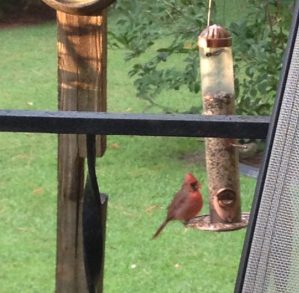 The mockingbird chased the other birds, unwilling to share…anything, even access to food he had no interest in. He wanted the whole habitat all to himself. It was all about him. And my nesting pairs of littler birds, who had come and made their homes in my yard, were kept from the feeders though they posed no risk, simply seeking to feed themselves and their babies.
Initially, it seemed the mockingbird was powerful. He had dominance and control. He even attracted a mate. Finally, however, the littler birds stood up for themselves, joining together, fighting back, and the mockingbird left, taking his song and his mate with him.
They haven’t been in my yard these last few years…and the other birds have flourished.
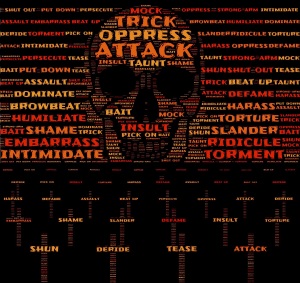 Now, thus far, this may seem just a tale of life in my garden…but it came to mind when I read last week’s post by a friend, entitled “Bullies”. She related stories from her days teaching and as a principal about bullies in her school….and went on to make it an analogy to the current election, having not posted about politics before. Link to Clare’s post, Bullies
Like her, I had never before specifically addressed individual candidates. But like Clare, I now feel compelled to speak in the face of the horrifying nature of this election. I am not willing to let a bully win, even if all I have to fight him with are my words.
 Donald Trump is a Mockingbird. He sings varied songs calling out to the scared, to the struggling white, formerly middle class, men in manufacturing and mining, some of his songs mock women, some mock Muslims, the handicapped, Mexicans, immigrants, the communities and neighborhoods where there are a preponderance of African-Americans, recently he mocked Clinton’s stumbling when she was sick, some of his songs resonate with the actively racist. He sees himself sitting at the edge of night, singing a song of a “great” past, and telling us he is our only possible savior. It is all about him.
 Like the Mockingbird, he wants to drive out others from “his” territory, keep out the “different,” remove illegal immigrants, keep out refugees, build walls. At one point, he kept African-Americans from renting in his buildings. He has “used” small businesses to feather his nest without paying them, gone bankrupt multiple times thus not paying his debts, hurting his sub-contractors, cheating his employees, and accruing that failure to his own benefit by paying no taxes at all to support the country, or its military, while criticizing how poorly our president has managed things.
He sings songs that are not even really his own, that he thinks people want to hear, “Keep jobs in America, Make companies bring back jobs, Make things in America” while his company makes shirts and ties in Asia and Central America.
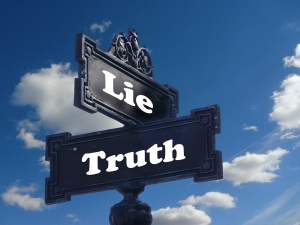 Donald Trump’s songs are alluring, and he is more than willing to change them…pretend he never sang the notes we all heard him sing. He lies. Not little white lies, but the big profound deceptive hurtful kind that can destroy individuals and undermine a nation. Like a mockingbird, he loves to attack others swooping in on them, “twittering” into the night.
 So little birds, it’s time to unite. We can’t sit safe on the edges, we can’t just stay in our nests, or let this mockingbird win. We have to defend our country and ourselves, and we have to call out this bird, this candidate, this charlatan for what he is.
We have to talk about this and we have to vote…and though I fear the song may linger, we must act and call out to our neighbors who are mesmerized by Trump, “Don’t listen to the mockingbird.” The actual end to the line from the Mockingbird song that I couldn’t remember is “The mockingbird is singing o’er her grave.” There’s meaning there.
So, together let us chirp and tweet and sing, write and speak up to encourage others to vote and to join their voices to ours in a morning song, a song of inclusion, a welcoming song, a song of joy.
That is what really makes America strong, and it’s why America has always been great.
 “Autumn is the Mellow Time.” William Allingham
 Fall is my favorite season and comes late here on the coast, slowly evolving, and lingers into December. I love this gentle unfolding of its graces.
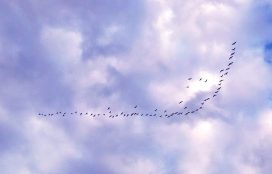
 Overhead geese cry, Come, Come, Come, Come,
 Autumn lulls us with whirring cicadas,
 But flights of geese arrow over head this morning, pointing me to answers, calling.
 Listen to the Salutation of the Dawn:
 For yesterday is but a dream
 Last week my family and I began texting, then calling, planning for the milestone birthday I celebrated on Sunday. I don’t know if people still think of 40 or 50 as “over the hill,” but this birthday sets me firmly, undeniable, over it. While I actually have never felt my age, and have more energy than many younger than me, some milestones are meant to make us take stock and reevaluate.
 You see on Saturday, on Facebook, a 60+ year old friend posted, “I continue to worry that I will die young.” Knowing him as tongue in cheek guy, my first reaction was humorous, “Too Late,” since I thought “continue” was inserted as a word clue he was kidding, that he was saying “too late” himself, poking fun at his age.


 Age is supposed to bring wisdom. This birthday is a reminder: Unlike when I was a kid and all of life lay ahead, age teaches us time is precious. There are still things I want to do and time with my grandkids to plan. So my mantra is two-fold: Focus on what matters and Live each moment to its full potential for joy.
 I’m gonna live till I die!
 Gonna dance, gonna fly,
 “Put one foot in front of the other. Turn off your TV. Power down your phone, say hi to your neighbor, and introduce yourself to a stranger. Connect. Be the unity you seek.” Joe Quinn
 We aren’t now. We’ve lost the sense of direction and shared purpose we had. Quinn reminded me that the unity that was so palpable then. has fragmented till it feels as if we are locked in armed camps. Sadly, this seems equally true in the rest of the world. The growth of nationalism, isolationism, the rejection of refugees and immigrants, even Brexit, seem to signal a withdrawal from connection, the kind of tribal dissension that has raged in the Middle East for generations.
 In America, two forces seem locked in combat and fearful animosity: Those who seek inclusion, unity with “the Other,” the offer of a helping people to those my faith calls “neighbor,” and a requirement for involvement in humanity; and on the other side, those who feel under personal attack, who feel left behind as the world moves forward, angered as their dreams slip from their grasp, they want to withdraw, put up walls, fall back, retrench, and protect themselves and those they love.
 There is no right or wrong here, just different life experience. The problem comes when these groups begin to characterize the others, labeling them, blaming them, destroying any sense of American unity.
 Sadly, in my opinion, the “pull yourself up by your bootstraps message” of our country doesn’t work well in a recession. It often doesn’t work well for minorities, the poor, or the undereducated. And jobs and work are changing in an increasingly technological world. I have lived where assembly line jobs at automotive plants and breweries were lost, where well-paying jobs disappeared as steel mills closed.
 I can understand and support the idea of meeting the needs of our own citizens first. Yet, I would ask, “Can’t those in tough circumstances empathize with those in even worse conditions? Can’t we try to be bigger, help more? Can’t we still be the land of hope, of opportunity for anyone seeking it.
 Together we can. United we can.
 A lion prowled a field in which Four Oxen lived. Over and over, he attacked them; but whenever he did they turned their tails to warn each another, and whichever way he attacked he was met by the horns of one of them. At last, however, they quarreled and each went off alone to separate corners of the field. Then, the Lion attacked them one by one and that was the end of all of them.
 The second is the story of a father whose sons are quarreling. He brings them a stick and a bundle of stick tied together. He breaks the single stick and asks them to try to break the bundle. They can’t. And he tells them, “My sons, if you unite to assist each other, you will be as this bundle, uninjured by all the attempts of your enemies; but if you are divided among yourselves, you will be broken as easily as this stick.”
 That is a lesson that has endured for several thousand years. We need to listen to it today, and reach across what divides us to the common ground that unites us. We can seek the common good and elevate ourselves and the world at the same time.
 Will we succeed in addressing every issue facing all of our citizens, and the world. Not easily, not the first time, and no, not with the first attempt. Yet, one of our strengths is perseverance. Americans aren’t quitters. In his article, Cohen used a Samuel Beckett quote to express this, “Ever tried. Ever failed. Try Again. Fail again. Fail Better.”
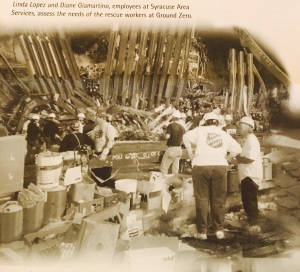
 Today is the 15th Anniversary of the terrorist attack on the Twin Towers and the Pentagon. I served at Ground Zero with The Salvation Army for several weeks in the immediate aftermath, arriving in New York City on September 14th. (I wrote a detailed memoire recounting my experience, the link to this is
 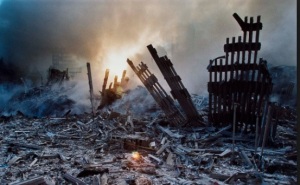 My husband, Doug, also went with our team, and even at that time both of us believed it could carry long-term consequences. The pervasive heavy grey dust we walked through, the smoke in the air, and the smell of the rising fumes were certainly warnings. and our aid station was in the debris field, initially on a fallen girder from the South Tower. (as right)
 Though Doug worked the 12 hour night shift with the Night Crawlers, and I was on a 12 hour “Day Watch,” we wrote notes and discussed it, even the possibility it would shorten our lives. Several times when the smoke was blowing toward us, the EPA told me the air “was bad.” But my team stayed. Both of us have had health consequences.
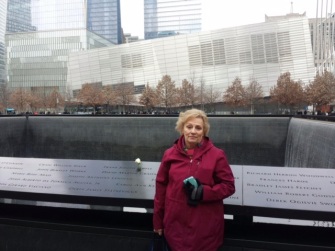 For us, somewhat like I have heard from family who served in World War II, our time there and our work there will always be the most meaningful experience in our lives. So, going back, visiting the Memorial Museum, seeing the fountains was something I have wanted to do for years. And just as I had hoped, going there with my daughter and sharing my memories with her, was poignant yet healing. Many things immediately triggered memories of our time at Ground Zero. (Above, me at one of the memorial fountains.
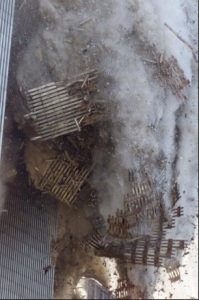 September 14th, our first day there, I had to climb through a broken window get into the site. The first things I saw, and I am sure you remember from iconic pictures, were twisted pieces of metal, girders, and large pieces of the exterior aluminum support sheathing which fell and embedded themselves into the ground.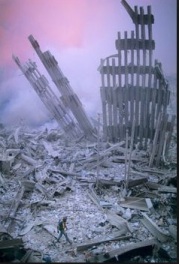
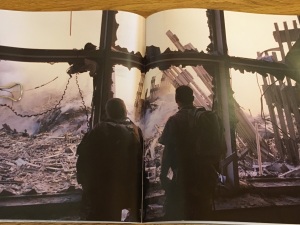
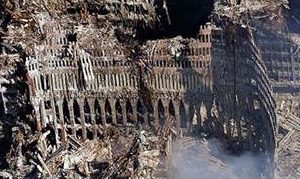 To the left of our girder were the remains from the bottom exterior of the North Tower (WTC1). Another iconic image to responders, these support arches held up the aluminum exterior sheath of the North Tower, reminding me of the arches seen inside gothic churches, and pictures of bombed churches in World War II. (on left)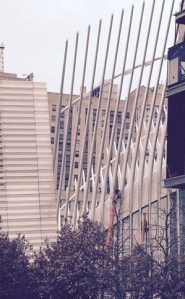
 It was the first sign to me of how hard the designers had worked to create a place of memory for people who had images of the disaster seared into their minds and linked to their grief, and simultaneously, it was an indication of resurrection and redirection. To me, these new teeth, reminders of pain, had become wings, attached to the earth into which the originals were imbedded, but reaching for the sky.
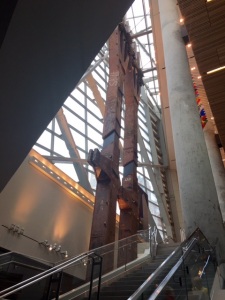 Because I knew this would be emotional to me, once inside I chose not join a group with a tour guide, but to go with my daughter at our own pace through the displays. As we descended the stairs to the below ground museum, we saw the first remains of the Trade Center. There was one of the North Tower “church” arches, against a multi-paned window reaching for the light. Again, pain yet relief, remembrance and transformation, but united by the same sense of entering a sacred place I felt every time I brought supplies for the first responders into Ground Zero.
 Then, we descended further next to the Survivor Stairs down which many in the North Tower escaped, and we reached the next amazingly sensitive piece of art, an immense wall of blue, a touching quote. Again, sharp memory.
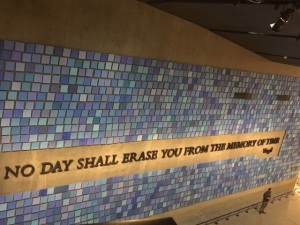 This quote from the Aeneid, “No Day Shall Erase You From The Memory of Time” is set against Spencer Finch’s immense blue art installation of 2,983 individual watercolor renderings by artists of what color the sky appeared to be to them that September 11th. Each one unique, the squares represent each person killed in the original attack in 1993 and those in 2001, each person as distinct in memory as the different colors of blue sky.
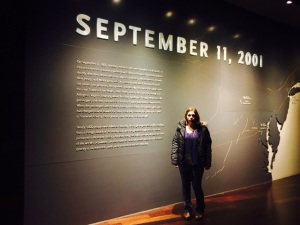 My daughter and I passed a preserved though damaged fire truck, a glass encased fireman’s helmet, a wall outlining flight paths and a step by step progression of events, the slurry wall that held, many pictures, and places to listen to audio recordings from that tragic day. So many stops, a Via Dolorosa of tears for me. I know it wasn’t easy for Gretchen to watch it hurt me. She has more empathy than most and I am sure she felt my pain. I think she also felt my healing.
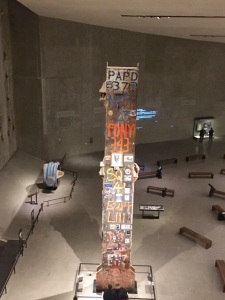 The last location I will share from the visit is aptly named “the Last Column.” During the clean up and recovery work that lasted until May 30, 2002, this support column from the southeast corner of the South Tower was left in place and intact to represent the resiliency of our country, to show that, despite this cowardly but devastating attack, America, like the column, was still standing.
 made me proud to have worked for The Salvation Army which on September 11th, as at all other times, truly was a strong army of salvation. The only agency authorized to serve inside the fenced perimeter, in a little more than 8 months, during Operation Compassion Under Fire, 39,000 officers, staff, and volunteers provided over 3 million meals and over 1 million volunteer hours.
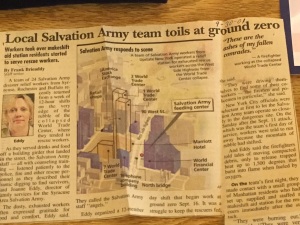 Perhaps, most importantly, Salvation Army counselors provided emotional and spiritual support in extraordinarily difficult circumstances to the brave rescue and recovery workers there. I was blessed to have been part of that effort.
 We must never forget that at Ground Zero, at the Pentagon, and on a Plane that crashed in a field in Shanksville, Pennsylvania, heroes arose among us. First responders, military personnel, the amazing passengers and crew of Flight 93 AND ordinary citizens who helped strangers down the stairs or led others crawling out of smoke-filled corridors, those who gathered supplies on girders, who brought in pizzas to Ground Zero, and boys and girls who packed lunches with colored pictures thanking the rescue workers, heroes arose among us.
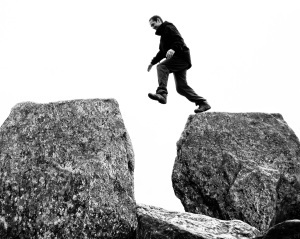 “Finding your calling — it’s not passive. When people have found their calling, they’ve made tough decisions and sacrifices in order to do the work they were meant to do. In other words, you don’t just ‘find’ your calling — you have to fight for it. And it’s worth the fight. People who’ve found their calling have a fire about them,” says Dave Isay, the winner of the 2015 TED Prize. “They’re the people who are dying to get up in the morning and go do their work.”
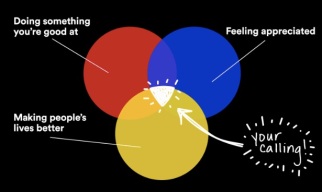 Webster defines a calling as “a strong inner impulse toward a goal or career, especially when accompanied by a conviction of divine influence; a profession or vocation.
 All three have been true in my life as I moved from teaching into social work, management, and therapy, and back to teaching. Working with others in these various forms has felt like just different versions of the same call to me. However, I don’t know if I agree with Mr. Isay that every calling results in appreciation or requires it.
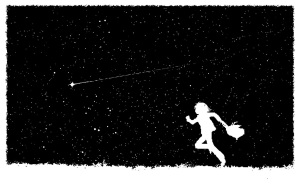 I find myself returning to this topic because finding and living my call is so central to my life, and because ultimately, I believe everyone has a calling. I think we are all meant to look for and live out a call and find that fulfillment sometimes in our work, sometimes in our avocations.
 This sense that life was meant to have meaning and that a purpose was there to be discovered started when I was very young. For me, though not for everyone, it is wrapped up in a sense that God, or the universe if you’d like, had a need for me to do my part in a bigger plan. As Frederick Buechner put it, “The place God calls you to is the place where your deep gladness and the world’s deep hunger meet.”
 For me, my calling has evolved. Now, I see my writing as a call. In my blog and in my novel, titled unsurprisingly, The Call, I am trying to share the awareness my work and life has brought me. I don’t know if there is any hunger for this in the world, or if there will ever be appreciation or recognition. I may or may not get my book published, or find an audience for my words. But as Dave Isay says, perhaps the work and the fight to keep doing it isn’t meant to be easy. It certainly can require persistence. But, at least for me, it is a necessity.
 So what is your calling? Is it something you’re doing or thinking about doing? Do you have something only you can share? Is your heart or mind pulling you or pushing you or are you searching for that sense of direction? Find it. Be who you are and who you are meant to be.
 Are you feeling fulfilled in what you are doing or struggling to find a meaning and a purpose? Are you out there seeking the “justice, glory, and worth” I dreamed of as a teen, or searching for something else? Do you need to practice or go back to school or change jobs or make the time to do what you know is important to you? Whatever it is: Do it. Don’t give up, don’t quit, keep going!
 Can you hear your call? It is saying, “You have a place in the world that is uniquely yours and the world needs you.” Come live it.
 “You’ve got to accentuate the positive,
 I remember in 1961 when President Kennedy said that we would put a man on the moon by the end of the decade. When he made that promise, we had only just achieved a sub-orbital flight by Alan Shepard. To leave our atmosphere, travel to the moon, and return was almost beyond imagining. It was an ambitious vision, some said a profoundly over-ambitious goal. Yet just over eight years later in the summer of 1969, we gathered around our televisions to watch as Neil Armstrong made his “one step” and humankind’s “giant leap” into space.
 It seems to me that we are in a wrestling match right now about America’s vision for itself and its leaders vision for us. I believe as individuals and as a country the Proverb “without vision, the people perish” applies, and I believe vision has to be positive, a forward-look that will carry us into a brighter future. True vision is never a backward glance, a yearning for the impossible hope of re-capturing the perfect past.
 It is easy to talk about and all too easy to believe in a cherry picked view of an idyllic past. We all have selective memory about those shinning moments, those golden days, and gloss over our past failures, pain, and wrong choices.
 as well as huge budget deficits and Tiananmen Square; the 90s saw the break-up of Soviet Union, but the rise of terrorism and the first attack on the World Trade Center; the 2000s saw increased the rise of al-Qaeda, the 2001 terrorism attacks, wars in Afghanistan and Iraq, the Banking Crisis and Great Recession, yet the election of the first African-American.
 The past held successes, but was far from perfect…except in romanticized memory.
 In fact, what I believe we need to do to move forward to a better future is to do what Kennedy did. We need to set positive, almost unachievable goals and reach for them. We need to ask, “What is the next “moonshot” for our country? What is the future dream for us as individuals?”
 That is what sets America apart. That is what has made the American dream a reality. We dream big and we believe in our dreams. Then, we achieve them.
 We need to move beyond our past to live in the future.
 But I’m telling you the tide is gonna turn,
 “When you look into my eyes
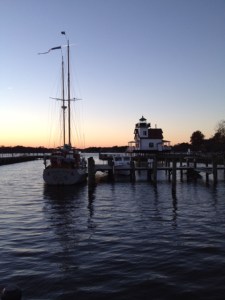 Home. Safety, love, comfort, celebration, the gathering place for family, a haven from the troubles of the world, the welcoming beacon to the wandering soul.
 and now, a house in a historic little town on the Albemarle Sound where they come with our grandchildren to visit with us and our dog. Some will always hold a place in my heart, some have just been a roof over our heads.
 But leaving was also freedom! No longer the monkey in the middle of my parents’ fights, trying to make my mother laugh and calm her resentment, no intervening with my father so he would belittle me instead of her.
 My true home was the love I had for Doug and the family that grew from that love.
 But when we do move to Raleigh, just like my move to Buffalo for college, this move will be a life changing one. It will be adventures into new opportunities, an exploration of where God is calling us next.
 “Fiction is the Truth behind the lie.” Stephen King
 Wanting to write for me, as for many including King, started as a love affair with words when I was a child. Words, books, transported me, made me laugh, moved me to tears, taught me important ideas and obscure facts, led me to adventures, and let me wander in other lands and lives. It was an escape and a delight. It called to something inside of me and made my heart sing. While there were many years when I only wrote grant applications and reports, that music lived within me until I had to let the song out.
 Words are thought given form leading the author to take pen to a blank page, or to tap words into a computer document. That interplay between the words and the writer’s mind and spirit is often lyrical, the flow seamless. Writing comes pouring out without any sense of effort on my part and I have no awareness of the computer or my individual fingers tapping a’s, t’s or m’s, no sense of myself, only story unfolding before me just as it did when I lay on my bed reading, immersed in the words of a book, oblivious to everything else. Those moments are magic, lightening captured, music swelling inside bursting free.
 I am not sure how anyone can teach anything about that kind of moment. I had one whole chapter, more than twenty pages, come to me that way once. It is the “history” chapter of my book and through all my edits and re-edits that chapter has stood virtually intact. But those moments, bursts of thought and words, lovely words, make writing alive to me.
 Easy or difficult, writing doesn’t end with that one on one interaction between writer and word. Writing is more. It is story, or exposition, and while story has its beginning in a writer’s head, even getting it on a page is not enough. Stories are intended to be told or read. If it is music, it may need to be orchestrated and fine tuned, but then it has to be sung. It requires an audience.
 To play with the Stephen King quote above, it is not enough that a story captures a writer’s truth. A story must be written in such a way that it resonates with a more universal Truth, the readers’ truth. Our magic moment, our lightning in the jar of our book, needs to strike a chord inside our reader, capture them and transport them, delighted or terrified, sad, or enraptured, challenged or stimulated into being a part of our story…solving the crime, helping the hero, rooting for our characters or hating the villain and trying to outwit him
 But the truth is from getting an idea as an ethereal concept floating in your mind, to thinking it through and researching and refining, to first draft, to editing, to querying, to publishing, every step has its own challenges….and different magical moments.
 I was the always a do her homework plus more person. Always hand up in the air, geeky underliner, write in the margins with notes like an out-line kind of student (always hit upon for my class notes). I first read King’s book years ago, yet much of it has stuck with me to this day. So I invite you to see this part of my post as my notes in the margins of On Writing.
 I am definitely not Stephen King, nor am I “a King-like writer.” I have read The Stand and watched the movies of Carrie and Stand By Me, but never made it through The Shining. We don’t write the same genre, but I admire him for the writer and especially the storyteller he is. No, he’s not Hemingway or Fitzgerald, but he can create feeling (I just don’t love fear and terror) and catch you up in his stories. His characters, if macabre, seem real. He does know his readers, and he knows what sells. He is a master of the craft.
 Where do a writer’s ideas come from? He says, “We never ask…other writers…where we get our ideas, we know we don’t know.” Yet, he shares life stories that presage some of his written stories. His mother told him about death and seeing a dead body, inspiration perhaps for “The Body” which became Stand By Me. He relates an anecdote that could lead to “Misery,” and rats in the attic at his grandmother’s house. He tells of watching “Poe Movies,” reading incessantly, and discussions with other writers. If King’s ideas come from some nebulous ether he can’t identify, I would say he filled that with reflections on his life and the stimulation from the thoughts of others, mixed with that quirky element that is his own unique, perhaps skewed and idiosyncratic, perspective.
 How do you handle rejection? He took a nail and tacked rejection letters to the wall over his desk….and when the weight made them fell down he got a bigger nail. Message to me: if rejection is getting to you hammer it harder, work harder, don’t quit until you get an acceptance. (Probably better than driving a nail through the email rejections on my computer screen!)
 Who do we write for? King’s answer is a great quote: “When you write a story, you are telling yourself a story. When you rewrite, your main job is taking out all the things that are not the story.” So in my note shorthand: The first draft is for me. The second, third and tenth are for the reader.
 “The critical distinction between anger and rage is related to time and intensity. Anger tends to arise “in the moment,” generating intensity that usually leads to an emotional
 A context: I am a clinical social worker and used to express a somewhat similar thought, but in the other direction. I often used to tell clients anger was hurt turned outward: that when their spouse or child or friend or colleague hurt them, turning that hurt back on the perpetrator with anger was common, but not necessarily the best response. It was a bit protective in providing distance from the one who inflicted hurt, and it could be emotional cathartic, but it rarely would solve the problem that led to them being hurt.
 I have also used a variant of the concept: that depression was anger turned inward. Sort of the next step from the above…that when the world hurts us and that angers us but we can’t or don’t express it, if instead we hold it in, perhaps even get mad at ourselves for not being able to stop the hurt, we can become overwhelmed, depressed, even despairing.
 The simple answer, and in some ways over-simplified answer is: We need to be able to stand up assertively (not aggressively or angrily or defensively) for ourselves. To do that we need to feel good enough about ourselves to face the “slings and arrows” of the world with a kind of impervious shield made of confidence and an awareness of what we believe in and can stand up for.
 But today, I have been thinking about the rage in our country that seems to be fueling some of our dissension in the current election.
 Unemployed blue-collar white men, former line workers in manufacturing plants, auto companies, steel mills, or coal mines who had able to achieve a middle class lifestyle through hard work and no longer can are caught in the throes of rage. Unfulfilled promises and failed answers have been compressed with frustration into outrage. They are flocking to the embrace of a man who has offered to “be their voice.” And he spews anger effectively, directing them to blame “the Other.” That is not the answer to the issue. Nor is it to be found in inflaming anger, or issuing veiled threats or calls to arms. But this post is not about him.
 I have liberal friends who are lambasting him and his followers. I understand why. He scares them. He scares me. And the crudeness and hatred voiced by some of his followers is ugly. He and they seem to relish it. Yet, the answer is not to cut it off and silence it, not until we hear the pain, the genuine underlying hurt in many of them that is all too real. To shout them down, or shut them up. will only fuel the rage.
 We need as a country to care about that. We need to begin to hold the powers that be to an accounting. The answer can never be to just say “No” to the other side. We need to insist that they sit down and hammer out compromises, and they work together to assure we offer that American possibility to all, regardless of race, gender or ethnicity or political party.
 America is better than this campaign and we are more than this election. We are not the land of quitters, and we are more than good losers. Our strength is not found in hating the other side opposing anything they try. Rather, like our founders, we need to set aside anger and work on solutions and compromises. We can find the answers, together.
 joanneeddy's blog